Question
Give balanced equations for $–$
  1. A direct combination reaction involving two elements, one of which is a nonmetal
  2. A thermal decomposition reaction involving heat on limestone $[$calcium carbonate$]$
  3. An electrolytic decomposition reaction involving a neutral liquid
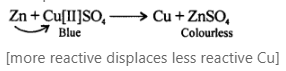
  4. A displacement reaction involving a metal above hydrogen in the activity series with copper $\ce{[II]}$ sulphate solution
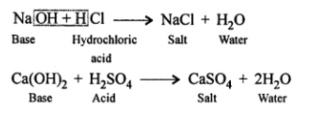
  5. A double decomposition neutralization reaction involving an acid $\&$ a base
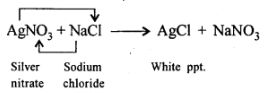
  6. A white precipitate obtained during a double decomposition reaction involving a silver salt with a sodium salt.
Answer

$1.$ Balanced chemical equation of: A combination reaction between calcium and oxygen $($non$-$metal$)$ to form calcium oxide.
$\ce{2Ca + O_2 \rightarrow 2 CaO}$
$2.$ Thermal decomposition of limestone :
$\underset{\substack{\text { Limestone }}}{ \ce{CaCO _3} \xrightarrow{\Delta} CaO + CO _2}$
$3.$ Electrolytic decomposition of neutral liquid $[$water$]$
$\ce{2H_2O} \xrightarrow[\text { Currenct }]{\text { Electicity }} \ce{2 H_2 + O_2}$
$4.$ Displacement reaction
Image
$5.$ Neutralization of acid with base to form salt and water.
Image
$6.$ Double decomposition reaction
Image

Need a full question paper?

Generate a complete, print-ready paper with questions like this in minutes — across 16+ boards, with answer keys.

Start Generating Free

Similar questions

State which of the following ions or radicals given below of non$-$metallic elements exhibit$-$valency : $1^–, 2^– \ \& \ 3^–$
$(a)$ Chloride
$(b)$ Bromide
$(c)$ Iodide
$(d)$ Nitrate
$(e)$ Hydroxide
$(f)$ Bicarbonate
$(g)$ Bisulphite
$(h)$ Bisulphate
$(i)$ Aluminate
$(j)$ Permanganate
$(k)$ Oxide
$(l)$ Sulphide
$(m)$ Sulphite
$(n)$ Sulphate
$(o)$ Carbonate
$(p)$ Dichromate
$(q)$ Zincate
$(r)$ Plumbite
$(s)$ Phosphate
$(t)$ Nitride
$[$write each ion or radical with the correct valency$]$
State five main assumptions of Dalton's atomic theory of matter.
In the laboratory preparation of carbon dioxide by action of a dilute acid on a metallic carbonate give $- (a)$ A balanced equation for the preparation $(b)$ A reason for $(i)$ use of a washer bottle containing cone. $\ce{H_2SO_4}$ in the preparation $(ii)$ Not collecting the prepared gas over water $(iii)$ Not using dilute sulphuric acid as a reactant in the preparation.
What happens to water if it is heated and Explain the phenomenon of change of state of water.
What happens during a chemical reaction ?
What are oxides ?
Differentiate between :
Periodic and non-periodic changes
Draw the atomic diagrams of the following elements showing the distribution of $-$ protons, neutrons  the electrons in the various shells of the atoms.
$a$. Carbon $-{ }^{12} C$
$b$. Oxygen $-{ }_8^{16} O$
$c$. Phosphorus $-{ }^{31}{ }_{15} P$
$d$. Argon $-{ }^{40}{ }_{18} Ar$
$e$. Calcium $-{ }_{20}^{40} Ca$
$[$The upper number represents the $-$ mass number $\ $ the lower number the $ -$ atomic number e.g. calcium $-$ mass number $=40$, atomic number $=20]$
Differentiate between: A balanced and an unbalanced chemical equation.
Suggest a suitable technique to separate the constituents of the following mixtures. Also give the reason for selecting the particular method. Salt from sea water