Question
Give brief explanation of a semi-conductor diode.

Answer

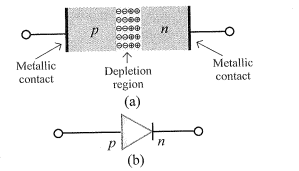
Image

A semiconductor diode is basically a $p-n$ junction with metallic contacts provided at the ends for the application of an external voltage. It is a two terminal device. A $p-n$ junction diode is symbolically represented as shown in fig. (b).
The direction of arrow indicates the conventional direction of current (When the diode is under forward bias.) The equilibrium barrier potential can be altered by an external voltage V across the diode.
The situation of $p-n$ junction diode under equilibrium (without bias) is shown in fig. (a) and (b).

Need a full question paper?

Generate a complete, print-ready paper with questions like this in minutes — across 16+ boards, with answer keys.
Start Generating Free

Similar questions

The threshold frequency for certain metal is $3.3 \times 10^{14}$ Hz If light of frequency $8.2 \times 10^{14}$ Hz is incident on the metal, predict the cut-off voltage for photoelectric emission.
Suppose, one wishes to construct a 1.0 farad capacitor using circular discs. If the separation between the discs be kept at 1.0mm, what would be the radius of the discs?
The density of an ideal gas is $1.25 \times 10^{-3}g\ cm^{3}$ at $\text{STP}$. Calculate the molecular weight of the gas.
A compound microscope uses an objective lens of focal length $4 \ cm$ and eyepiece lens of focal length $10 \ cm$. An object is placed at $6 \ cm$ from the objective lens. Calculate the magnifying power of the compound microscope. Also calculate the length of the microscope.
The work function for the following metals is given: $Na: 2.75 eV; K: 2.30 eV; Mo: 4.17 eV; Ni: 5.15 eV.$ Which of these metals will not give photoelectric emission for a radiation of wavelength $3300 \mathring A$ from a $He-Cd$ laser placed $1 m$ away from the photocell? What happens if the laser is brought nearer and placed $50 \ cm$ away?
Classify metals, conductors and semiconductors.
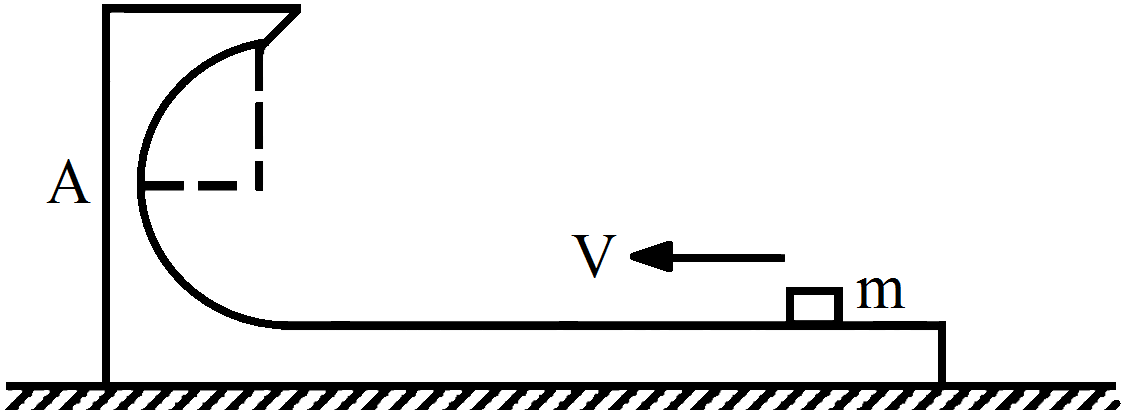
Figure shows a small block of mass m which is started with a speed v on the horizontal part of the bigger block of mass M placed on a horizontal floor. The curved part of the surface shown is semicircular. All the surfaces are frictionless. Find the speed of the bigger block when the smaller block reaches the point A of the surface.
Define critical angle and write the conditions of total internal reflection.
Explain with example, whether the neutron-proton ratio in a nucleus increases or decreases due to $\beta-$decay.
A semiconducting material has a band gap of 1eV. Acceptor impurities are doped into it which create acceptor levels 1meV above the valence band. Assume that the transition from one energy level to the other is almost forbidden if kT is less than $\frac{1}{50}$ of the energy gap. Also, if kT is more than twice the gap, the upper levels have maximum population. The temperature of the semiconductor is increased from 0K. The concentration of the holes increases with temperature and after a certain temperature it becomes approximately constant. As the temperature is further increased, the hole concentration again starts increasing at a certain temperature. Find the order of the temperature range in which the hole concentration remains approximately constant.