Question
Give brief explanation of modern solid state semi-conductor electronics.

Answer

The seed of the development of the modern solid-state semiconductor electronics goes back to 1930 's.
Then it was realized that some solid state semiconductors and their junctions offer the possibility of controlling the number and the direction of flow of charge carriers through them.
Simple excitations like light, heat or small applied voltage can change the number of mobile charges in a semiconductor, and hence can control the current. which means they act as a catalyst.
Note that the supply and flow of charge carriers in the semiconductor devices are within the solid itself.
Unlike the vacuum tubes/valves, no external heating or large evacuated space is required by the semi-conductor devices.
They are small in size, consume low power, operate at low voltages and have long life and high reliability.
Even the Cathode Ray Tubes (CRT) used in television and computer monitors which work on the principle of vacuum tubes are being replaced by Liquid Crystal Display (LCD) monitors with supporting solid state electronics.
Much before the full implications of the semiconductor devices were formally understood, a naturally occurring crystal of galena (lead sulphide, PbS ) with a metal point contact attached to it was used as a detector of radio waves.
Need a full question paper?

Generate a complete, print-ready paper with questions like this in minutes — across 16+ boards, with answer keys.

Start Generating Free

Similar questions

Answer the following question:
Ray optics is based on the assumption that light travels in a straight line. Diffraction effects (observed when light propagates through small apertures/slits or around small obstacles) disprove this assumption. Yet the ray optics assumption is so commonly used in understanding location and several other properties of images in optical instruments. What is the justification?
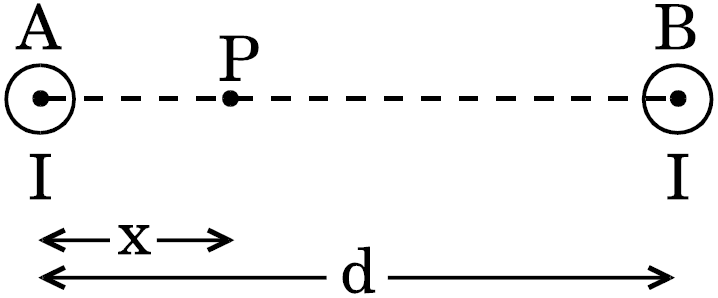
Two long straight parallel wires A and B separated by a distance d, carry equal current I flowing in same direction as shown in the figure.
  1. Find the magnetic field at a point P situated between them at a distance x from one wire.
  2. Show graphically the variation of the magnetic field with distance x for 0 < x < d.
What is diffraction? Which are the factors on which diffraction depends ? Give some examples of day to day life where the diffraction phenomenon is observed.
Can you add two vectors representing physical quantities having different dimensions? Can you multiply two vectors representing physical quantities having different dimensions?
Draw a labelled diagram of an astronomical telescope.
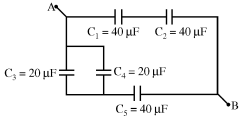
If five capacitors $C_1, C_2, C_3, C_4, C_5$ are connected in an electric circuit as shown in the figure, then calculate the equivalent capacitance of this network between point $A$ and point $B$.
Image
A parallel plate capacitor of capacitance C is charged to a potential V. It is then connected to another uncharged capacitor having the same capacitance. Find out the ratio of the energy stored in the combined system to that stored initially in the single capacitor.
Is neutral temperature always the arithmetic mean of inversion temperature and the temperature of the cold junction? Does the unit of temperature have an effect in deciding this question?
When a train starts, the head of a standing passenger seems to be pushed backward. Analyse the situation from the ground frame. Does it really go backward? Coming back to the train frame, how do you explain the backward movement of the head on the basis of Newton's laws?
Explain why the spectrum of hydrogen atom has many lines, although a hydrogen atom contains only one electron.