Question
Give brief explanation of modern solid state semi-conductor electronics.

Answer

The seed of the development of the modern solid-state semiconductor electronics goes back to 1930 's.
Then it was realized that some solid state semiconductors and their junctions offer the possibility of controlling the number and the direction of flow of charge carriers through them.
Simple excitations like light, heat or small applied voltage can change the number of mobile charges in a semiconductor, and hence can control the current. which means they act as a catalyst.
Note that the supply and flow of charge carriers in the semiconductor devices are within the solid itself.
Unlike the vacuum tubes/valves, no external heating or large evacuated space is required by the semi-conductor devices.
They are small in size, consume low power, operate at low voltages and have long life and high reliability.
Even the Cathode Ray Tubes (CRT) used in television and computer monitors which work on the principle of vacuum tubes are being replaced by Liquid Crystal Display (LCD) monitors with supporting solid state electronics.
Much before the full implications of the semiconductor devices were formally understood, a naturally occurring crystal of galena (lead sulphide, PbS ) with a metal point contact attached to it was used as a detector of radio waves.
Need a full question paper?

Generate a complete, print-ready paper with questions like this in minutes — across 16+ boards, with answer keys.

Start Generating Free

Similar questions

Draw a circuit diagram using a metre bridge and write the necessary mathematical relation used to determine the value of an unknown resistance. Why cannot such an arrangement be used for measuring very low resistances?
The equation $\omega=\frac{\mu_\text{v}-\mu_\text{r}}{\mu-1}$ asderived for a prism having small refracting angle. Is it also valid for a prism of large refracting angle? Is it also valid for a glass slab or a glass sphere?
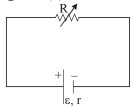
A variable resistor R, electromotive force and internal resistance $r$ are joined as shown in the given figure across the ends of the cell. Draw graph to show (i) terminal voltage and (ii) current $I$ as a function of $R$.
Image
By which different ways can magnetic flux linked with a conducting coil be changed ?
The force on a charged particle due to electric and magnetic fields is given by $\overrightarrow{\text{F}}=\text{q}\overrightarrow{\text{E}}+\text{q}\overrightarrow{\text{v}}\times\overrightarrow{\text{B}}.$ Suppose $\overrightarrow{\text{E}}$ is along the X-axis and $\overrightarrow{\text{B}}$ along the Y-axis. In what direction and with what minimum speed v should a positively charged particle be sent so that the net force on it is zero?
Explain electricity conduction in intrinsic semi-conductors.
Answer the following question:
Magnifying power of a simple microscope is inversely proportional to the focal length of the lens. What then stops us from using a convex lens of smaller and smaller focal length and achieving greater and greater magnifying power?
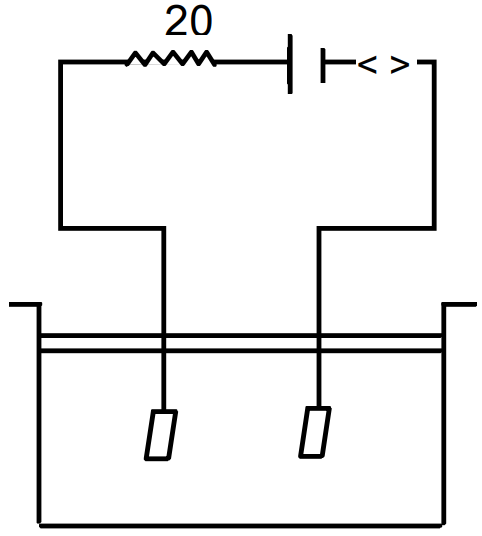
Figure shows an electrolyte of AgCl through which a current is passed. It is observed that 2.68g of silver is deposited in 10 minutes on the cathode. Find the heat developed in the $20\Omega$ resistor during this period. Atomic weight of silver is 107.9g/mole.

The mutual inductance between two coils is 2.5H. If the current in one coil is changed at the rate of 1A/s, what will be the emf induced in the other coil?
A source emitting light of wavelengths 480nm and 600nm is used in. a double slit interference experiment. The separation between the slits is 0.25mm and the interference is observed on a screen placed at 150cm from the slits. Find the linear separation between the first maximum (next to the central maximum) corresponding to the two wavelengths.