Question
Give brief information about the solenoid.

Answer

Solenoid : "A helical coil consisting of closely wound turns of insulated conducting wire is called a solenoid."
→If the length of a solenoid is very large as compared to its radius, the solenoid is called long solenoid.
→Solenoid consists of a long wire wound in the form of a helix where the turns are closely spaced. Hence, each turn can be considered as a circular loop.
→The total magnetic field of solenoid is the vector sum of the fields due to all the turns.
→Enamelled wires are used for winding to make turns insulated from each other.
Image

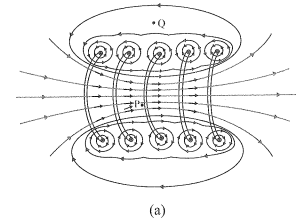
(a) The magnetic field due to a section of the solenoid which has been stretched out for clarity. Only the exterior semicircular part is shown. Notice how the circular loops between neighbouring turns tend to cancel.
Image

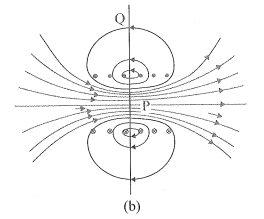
(b) The magnetic field of a finite solenoid.
→Figure shows the magnetic field lines for a finite solenoid.
→It is clear from the figure (a) that the magnetic field of the circular loop between two neighbouring turns cancel out each other (in opposite direction)
→From the figure (b), it can be seen that the magnetic field is uniform, strong and in the direction of its axis at the mid point P inside the solenoid.
→While the magnetic field at the outer mid point Q is weak and almost parallel to the axis of the solenoid.
→ As the solenoid is made longer it looks like a long cylindrical metal sheet.
→Here we assume that for a long solenoid, the magnetic field outside the solenoid is zero, while inside the magnetic field is parallel to the axis every where.
Need a full question paper?

Generate a complete, print-ready paper with questions like this in minutes — across 16+ boards, with answer keys.

Start Generating Free

Similar questions

Sketch graph to show how charge Q given to a capacitor of capacitance C varies with the potential difference.
Find the number of molecules in $1\ cm^3$ of an ideal gas at $0^\circ C$ and at a pressure of $10^{-5} \ mm $ of mercury.
Equipotential surfaces are 5 cm apart from each other. How much work will be required to move a 500 µC charge between distant points?
The temperatures of the junctions of a bismuth$-$silver thermocouple are maintained at $0^\circ C$ and $0.001^\circ C$. Find the thermo-emf $($Seebeck emf$)$ developed. For bismuth$-$silver$, a = -46 \times 10^{-6}V^\circ C-^1$ and $b = -0.48 \times 10^{-6} V^\circ C^{-2}.$
Suppose, we think the fission of a ${ }_{26}^{56} Fe$nucleus into two equal fragments, ${ }_{13}^{28} Al$.Is this fission energetically possible? Argue by working out Q of the process.
Given : $m\left({ }_{26}^{56} Fe \right)=55.93494 u$
and $\quad m\left({ }_{13}^{28} Al \right)=27.98191 u$
A circular coil of N turns and radius R carries a current I. It is unwound and rewound to make another coil of radius R/2, current I remaining the same. Calculate the ratio of the magnetic moments of the new coil and the original coil.
Sketch the magnetic field lines for a current-carrying circular loop near its centre. Replace the loop by an equivalent magnetic dipole and sketch the magnetic field lines near the centre of the dipole. Identify the difference.
Calculate the current through the circuit and the potential difference across the diode shown in figure. The drift current for the diode is $20\mu\text{A}.$
In a Young's double slit experiment $\lambda=500\ \text{nm}, d = 1.0\ mm$ and $D = 1.0m$. Find the minimum distance from the central maximum for which the intensity is half of the maximum intensity.
Derive the formula for the magnetic fieid produced by a current-carrying circular coil as a magnetic dipole on its axis and equator. (Perpendicular bisector.)