Question
Give examples of first order reaction.

Answer

$\rightarrow$ Hydrogenation of ethene is an example of first order reaction.
$ \ce{C_2H_4(g) + H_2(g) \rightarrow C_2H_6(g)}$
$\text { Rate }= k \left[ C _2 H _4\right]$
All natural and artificial radioactive decay of unstable nuclei take place by first order kinetics. ${ }_{88}^{226} Ra \rightarrow{ }_2^4 He \ +\ { }_{86}^{222} Rn$
$\text { Rate }= k [ Ra ]$
Decomposition of $\ce{N_2O_5}$ and $\ce{N_2O}$ are some more examples of first order reactions.

Need a full question paper?

Generate a complete, print-ready paper with questions like this in minutes — across 16+ boards, with answer keys.
Start Generating Free

Similar questions

Short note on $:$ Cellulose.
Explain the difference between globular and fibrous proteins.
What happens when surcose is heated with dilute $H _2 SO _4$ or dilute HCl ?
Give reasons for the following observations:The treatment of alkyl chloride with aqueous KOH leads to the formation of alcohol but in the presence of alcoholic KOH, alkene is the major product.
Complete the following reaction by identifying A, B and C.
$\text{A}+\text{H}_2\text{(g)}\xrightarrow{ \ \ \text{Pd/BaSO}_4\ \ }\text{(CH}_3)_2\text{CH}-\text{CHO}$
The rate constant for the first order decomposition of $H_2O_2$​​​​​​​ is given by the following equation:$\log{k}=14.2-\frac{\text{1.0}\times\text{10}^{4}}{\text{T}}K$
Calculate $E_a​​​​​​​$ for this reaction and rate constant k if its half$-$life period be $200$ minutes.
$($Given: $R = 8.314 J K^{–1} mol^{–1})$
An organic compound ‘$X$’ having molecular formula $\ce{C_4H_8O}$ gives orange $-$ red ppt. with $2, 4-\ce{DNP}$ reagent. It does not reduce Tollens’ reagent but gives yellow ppt. of iodoform on heating with $\ce{NaOI}$. Compound $X$ on reduction with $\ce{LiAlH_4}$ gives compound ‘$Y$’ which undergoes dehydration reaction on heating with conc. $\ce{H_2SO_4}$ to form But $-2$-ene. Identify the compounds $X$ and $Y$.
Explain classification of haloalkane and haloarene on the basis of number of halogen atoms.
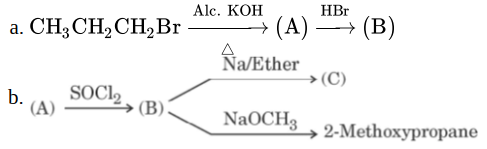
Complete the following reactions:
Image
Compare the general characteristics of the first series of the transition metals with those of the second and third series metals in the respective vertical columns. Give special emphasis on the following points: Oxidation states