Question
Give examples where:
  1. The velocity of a particle is zero but its acceleration is not zero.
  2. The velocity is opposite in direction to the acceleration.
  3. The velocity is perpendicular to the acceleration.
Answer

Particle thrown upwards:
  1. At highest point.
  2. While going up.
  3. At the highest point of projectile.

Need a full question paper?

Generate a complete, print-ready paper with questions like this in minutes — across 16+ boards, with answer keys.

Start Generating Free

Similar questions

Metallic (nonferromagnetic) and nonmetallic particles in a solid waste may be separated as follows. The waste is allowed to slide down an incline over permanent magnets. The metallic particles slow down as compared to the norunetallic ones and hence are separated. Discuss the role of eddy currents in the process.
Explain Inductance. Give its unit and dimensions.
The magnetic force depends on v which depends on the inertial frame of reference. Does then the magnetic force differ from inertial frame to frame? Is it reasonable that the net acceleration has a different value in different frames of reference?
Answer the following question:
Magnifying power of a simple microscope is inversely proportional to the focal length of the lens. What then stops us from using a convex lens of smaller and smaller focal length and achieving greater and greater magnifying power?
Two metals A and B have work functions 4eV and 10eV respectively. Which metal has the higher threshold wavelength?
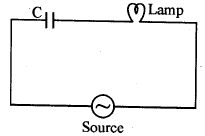
An electric lamp having coil of negligible inductance connected in series with a capacitor and an AC source is glowing with certain brightness. How does the brightness of the lamp change on reducing the (i) capacitance, and (ii) the frequency? Justify your answer.

What is electromagnetic wave? How is its speed is related with permittivity and permeability of the medium?
Explain the formation of potential barrier and depletion region in a p-n junction diode. What is effect of applying forward bias on the width of depletion region?
Write down the conditions for constructive and destructive interference in terms of path difference.
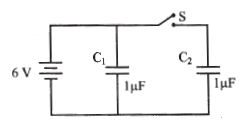
Figure shows two identical capacitors, C1 and C2, each of 1 μF capacitance connected to a battery of 6 V. Initially switch 'S' is closed. After sometime 'S' is left open and dielectric slabs of dielectric constant K = 3 are inserted to fill completely the space between the plates of the two capacitors. How will the (i) charge and (ii) potential difference between the plates of the capacitors be affected after the slabs are inserted?