Question
Give information about C-O-H bond angle in alcohol, phenol and ether with suitable example.
Answer

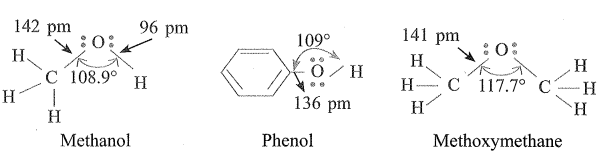
→ In alcohols, the oxygen of -OH group is attached to carbon by a sigma ($\sigma$) bond formed by the overlap of an sp3 hybridised orbital of carbon with sp3 hybridised orbital of oxygen.
→ Figure depicts structural aspects of methanol, phenol and methoxymethane.
Image
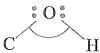
→ The bond angle Imagein alcohols is slightly less than the tetrahedral angle (109°-28').
→ It is due to the repulsion between the unshared electron pairs of oxygen.
→ In phenols, the OH group is attached to sp2 hybridised carbon of an aromatic ring.
→ The carbon-oxygen bond length (136 pm) in phenol is slightly less than that in methanol.
→ This is due to (i) partial double bond character on account of the conjugation of unshared electron pair of oxygen with the aromatic ring and (ii) sp2 hybridised state of carbon to which oxygen is attached.
→ In ethers, the four electron pairs, i.e., the two bond pairs and two lone pairs of electron on oxygen are arranged approximately in a tetrahedral arrangement.
→ The bond angle is slightly greater than the tetrahedral angle due to the repulsive interaction between the two bulky (-R) groups.
→ The C-O bond length (141 pm) is almost the same as in alcohols.

Need a full question paper?

Generate a complete, print-ready paper with questions like this in minutes — across 16+ boards, with answer keys.

Start Generating Free

Similar questions

What happens when D-glucose is treated with the following reagents?
  1. HI.
  2. Bromine water.
  3. HNO3.
E° values of Mn, Ni and Zn are more negative than expected.
The following data were obtained during the first order thermal decomposition of N2O5(g) at a constant volume:
2N2O5(g) → 2N2O4(g) + O2(g)
S. No. Time/s Total pressure/atm
1. 0 0.5
2. 100 0.512
Calculate the rate constant.
What is half-life of a reaction? Derive formula for half-life of zero and first order reaction.
Write one chemical equation for each, to illustrate the following reactions:
  1. Rosenmund reduction.
  2. Cannizzaro reaction.
  3. Fischer esterification.
  1. The cell in which the following reaction occurs:

2 Fe3+ (aq) + 2 I- (aq) $\longrightarrow$ 2 Fe2+ (aq) + I2 (s)

has $\text{E}^0_{\text{cell}}$ = 0·236 V at 298 K. Calculate the standard Gibbs energy of the cell reaction. (Given : 1 F = 96,500 C mol-1)
  1. How many electrons flow through a metallic wire if a current of 0·5 A is passed for 2 hours? (Given : 1 F = 96,500 C mol-1)
How would you account for the following? 
  1. Many of the transition elements are known to form interstitial compounds.
  2. The metallic radii of the third (5d) series of transition metals are virtually the same as those of the corresponding group members of the second (4d) series.
  3. Lanthanoids form primarily +3 ions, while the actinoids usually have higher oxidation states in their compounds, +4 or even +6 being typical.
Explain negative deviation from Raoult's law with an example.
Explain the following reaction of $C _2 H _5 OH$ :
(a) Schotten Baumann reaction
(b) Reaction with concen. $HNO _3$
(c) Reaction with excess of $NH _3$
(d) Reduction with Red P and HI