Question
Give one example each of central force and non - central force.

Answer

Gravitational force, electrostatic force due to point mass and point charges are the examples of central force. Spin dependent nuclear force, magnetic force between two current carrying loops are the examples of non - central forces.

Need a full question paper?

Generate a complete, print-ready paper with questions like this in minutes — across 16+ boards, with answer keys.
Start Generating Free

Similar questions

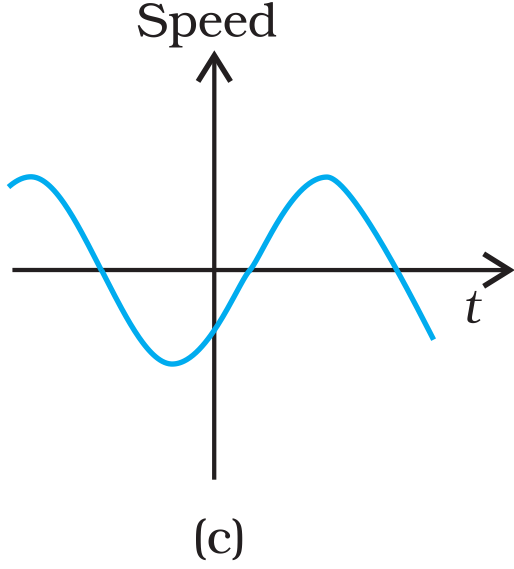
Look at the graphs carefully and state, with reasons, which of these cannot possibly represent one-dimensional motion of a particle.

A tightly closed metal lid of a glass bottle can be opened more easily if it is put in hot water for some time. Explain.
On what factor does the escape speed from a surface depend?
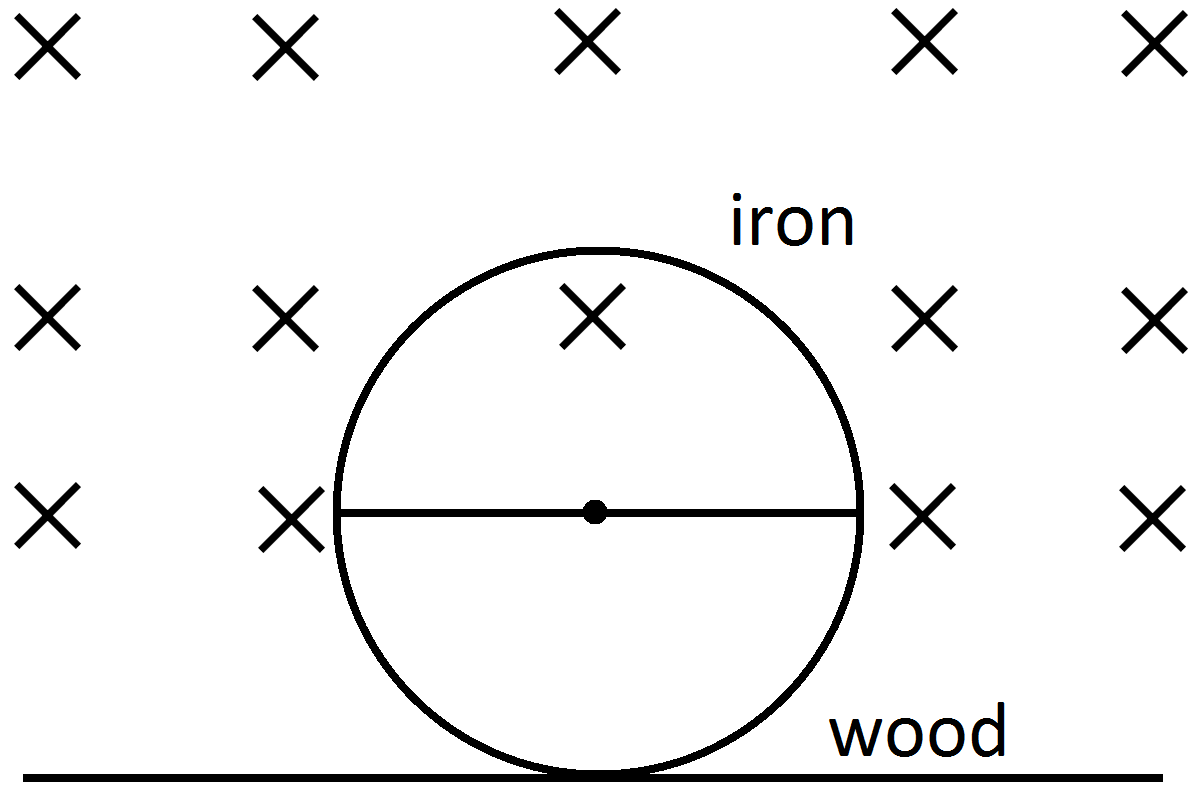
Figure shows a circular wheel of radius 10.0cm whose upper half, shown dark in the figure, is made of iron and the lower half of wood. The two junctions are joined by an iron rod. A uniform magnetic field B of magnitude 2.00 × 10⁻⁴ T exists in the space above the central line as suggested by the figure. The wheel is set into pure rolling on the horizontal surface. If it takes 2.00 seconds for the iron part to come down and the wooden part to go up, find the average emf induced during this period.

"Monochromatic light should be used to produce pure spectrum". Comment on this statement.
At a point above the surface of the earth, the gravitational potential is $-5.12 \times 10^7 J / kg$ and the acceleration due to gravity is $6.4 m / s ^2$. Assuming the mean radius of the earth to be 6400 km , calculate the height of the point above the earth's surface.
A hollow sphere filled with water is used as the bob of a pendulum. Assume that the equation for simple pendulum is valid with the distance between the point of suspension and centre of mass of the bob acting as the effective length of the pendulum. If water slowly leaks out of the bob, how will the time period vary?
If position of a particle at instant t is given by x = t3, find acceleration of the particle.
The motion of a particle of mass $m$ is described by $y=u t+\frac{1}{2} g t^2$. Find the force acting on the particle.
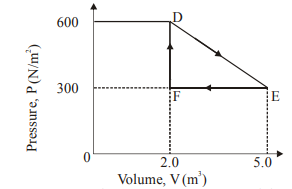
A thermodynamic system is taken from an original state to an intermediate state by the linear process shown in Fig.
Image

Its volume is then reduced to the original value from E to F by an isobaric process. Calculate the total work done by the gas from D to E to F.