Question
Give one example each of unisexual and bisexual flowers. Differentiate between the two types of pollination that occur in flowers. What happens when a pollen lands on a suitable stigma? Write about the events that occur till the seed formation in the ovary.
Answer

Unisexual Flower: Papaya/Watermelon.
Bisexual Flower: Hibiscus/Rose.
Self-pollination: The pollen grains are transferred from the anther to the stigma of the same flower or to the flower of the same plant.
Cross pollination: The pollen grains are transferred from the anther to the stigma of a flower of a different plant.
  • After pollen lands on a suitable stigma, a pollen tube grows out of pollen grain and travels through the style to reach the ovary.
  • The male germ cell fuses with the female germ cell to form a zygote.
  • Zygote divides several times to form an embryo within the ovule.
  • The ovule develops tough coat and gradually gets converted into a seed.

Need a full question paper?

Generate a complete, print-ready paper with questions like this in minutes — across 16+ boards, with answer keys.

Start Generating Free

Similar questions

Describe the structure of graphite with the help of a labelled diagram.
Draw a labelled diagram of:
  1. A xylem vessel.
  2. A sieve tube (or phloem).
a. With the help of Mendel's experiments show that
i. traits may be dominant or recessive, and
ii. traits are inherited independently.
b. Birds and bats are more closely related to each other than to squirrels or lizards. Comment.
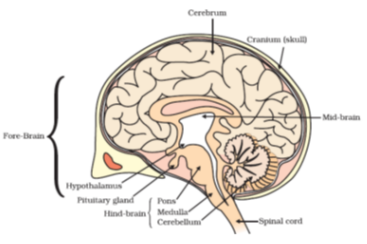
Given below is a labelled diagram of the human brain.

Image

Using the given diagram, answer the following questions:
i. Which part of the brain controls reflex movements of the head, neck, and trunk?
ii. Name the part of the human brain which contains a vital centre for controlling blood pressure.
iii. Which part of the hindbrain regulates respiration?
iv. How is the brain protected from injuries and shock?
v. Which part of the human brain is the main thinking region?
The speed of light in vacuum and in two different glasses is given in the table below:
Medium
Speed of light
Vacuum
Flint glass
Crown glass
$3.00 \times 10^8 m / s$
$1.86 \times 10^8 m / s$
$1.97 \times 10^8 m / s$
  1. Calculate the absolute refractive indexes of flint glass and crown glass.
  2. Calculate the relative refractive index for light going from crown glass to flint glass.
A, B and C are three common STDs. A and C are caused by bacteria whereas B is caused by a virus D. The virus D reduces the immunity of the infected person to such a low level that the person can die of even very mild diseases.
  1. What could A and C be?
  2. What is B?
  3. Name the virus D?
  4. How can A, B and C be caused?
  5. Out of A, B and C, which one does not have a definite cure as yet?
What are the disadvantages of using nuclear power?
  1. A student suffering from myopia is not able to see distinctly the objects placed beyond 5 m. List two possible reasons due to which this defect of vision may have arisen. With the help of ray diagrams, explain.
  1. Why the student is unable to see distinctly the objects placed beyond 5 m from his eyes.
  2. The type of the corrective lens used to restore proper vision and how this defect is corrected by the use of this lens.
  1. If, in this case, the numerical value of the focal length of the corrective lens is 5 m, find the power of the lens as per the new Cartesian sign convention.
A non-metal $A$ which is the largest constituent of air, when heated with $H _2$ in $1: 3$ ratio in the presence of catalyst ( Fe ) gives a gas B . On heating with $O _2$, it gives an oxide C . If this oxide is passed into water in the presence of air, it gives an acid D which acts as a strong oxidizing agent.
i. Identify A, B, C and D.
ii. To which group of the periodic table, does this non-metal belongs?
How can we explain the reddish appearance of sun at sunrise or sunset? Why does it not appear red at noon?