Question
Give preventive methods by giving examples of corrosion?

Answer

Corrosion can be prevented by the following methods:
  1. Galvanizing: Galvanizing is a process of giving a thin coating of zinc on iron or steel materials to protect them from corrosion. Zinc, being more electropositive than iron, undergoes corrosion first. Thus, it prevents corrosion of iron. However, if zinc layer goes away and the inner iron gets exposed, then the inner iron layer will start to rust.
  2. Tinning: Tinning is the process of giving a coating of tin over other metals. Cooking vessels, made of copper and brass get a greenish coating due to corrosion. This greenish coating is poisonous. If food is kept in such a vessel, it gets spoiled. Therefore, copper and brass vessels are coated with tin (kalhai) to prevent corrosion.
  3. Anodizing: The process of coating metals such as aluminium and copper with a thin and strong layer of their oxides by electrolysis is called anodizing process. For this, the copper or aluminium article is used as the anode. As this oxide layer is strong and uniform all over the surface, it is useful for the prevention of the corrosion of the metal.
  4. Electroplating: Electroplating is the process in which a less reactive metal is coated on a more reactive metal by electrolysis. It protects the object made of reactive metal from corrosion. For example, silver-plated spoons, gold plated ornaments, etc.
  5. Alloying: The homogenous mixture formed by mixing metal with other metals or nonmetals in a certain proportion is called an alloy Alloying helps to decrease the intensity of corrosion of metals. For example, stainless steel does not get stains with air or water and also does not rust. It is an alloy made from 74% iron, 18% chromium and 8% carbon.

Need a full question paper?

Generate a complete, print-ready paper with questions like this in minutes — across 16+ boards, with answer keys.
Start Generating Free

Similar questions

Explain the following with the help of a diagram :
Presbyopia
What are the objectives of mock drill?
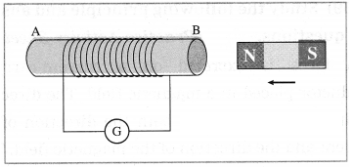
Take a coil AB having 10-15 turns. Connect the two ends of the coil to the galvanometer as shown in Figure. Take a strong bar magnet. (1) Move the north pole of the magnet towards the end B of the coil.
Image

Observe the deflection of the pointer in the galvanometer. Note the direction of the deflection (i.e. right or left). (2) Now repeat this with the south pole of the magnet towards the end B of the coil. Again observe the deflection. Note its direction. (3) What will happen if instead of the magnet, the coil is moved? (4) If both the coil and the magnet are kept stationary, do you observe any deflection? (5) Compare the direction of the deflection when the north pole of the magnet is moved towards the end B of the coil with that when the end B of the coil is moved away from the north pole of the magnet. (6) What conclusions do you draw from the observations?

What are the objectives of disaster management?
Draw a neat labelled diagram: Hydraulic separation method.
An element $X$ forms two oxides $XO$ and $XO_2$. The oxide XO has no action on litmus solution but oxide $XO_2$ turns litmus solution red.
  1. What is the nature of oxide $XO?$
  2. What is the nature of oxide $XO_2?$
  3. Would you call element $X$ a metal or a non-metal? Give reason for your choice.
  4. Can you give an example of element like $X?$ 
Explain with an example, how genes control the characteristics (or traits).
Write in brief about progressive changes in animal classification.
A certain form of energy is available due to the difference in the temperature of water at the surface of the ocean and its deeper levels.
  1. Name the form of energy.
  2. Is this energy ultimately derived from the sun or not?
  3. Explain how this form of energy can be converted into electricity.
  4. What is the minimum temperature difference in water at the surface of ocean and its deeper level which is required to operate power plants based on this energy?
P and Q are two types of plants having weak stems which cannot stand upright on their own. The plants P and Q have organs R and S respectively which can grow towards any support which they happen to touch and wind around that support. It is observed that organ R originates from the leaves of the plant whereas organ S originates directly from the stem of the plant.
  1. What is (i) R, and (ii) S?
  2. What is the name of growth movement exhibited by the organs R and S?
  3. Name the stimulus involved in this case.
  4. State whether the behaviour of organs R and S is a tropic movement or a nastic movement.
  5. Name one plant like P and another plant like Q.