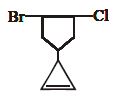
- ✓$3-(3-$ Bromo $-4-$ chlorocyclopentyl)cyclopropene
- B$3-(3-$ chloro $-4-$ bromocyclopentyl) cyclopropene
- C$2-(3-$ bromo $-4-$ chlorocyclopentyl) cyclopropene
- D$2-(3-$ chloro $-4-$ bromocyclopentyl) cyclopropene

Generate a complete, print-ready paper with questions like this in minutes — across 16+ boards, with answer keys.
Compound $(X)$ $\xrightarrow[{Pt}]{{5{H_2}}}$
Compound $(X)$ $\xrightarrow{{AgN{O_3}}}$ Precipitate
Compound $(X)$ $\xrightarrow[{M{e_2}S}]{{{O_3}}}$ $\begin{array}{*{20}{c}}
{\,\,\,\,\,\,\,O\,\,\,\,\,\,\,\,\,\,\,\,\,\,\,\,\,\,\,\,\,\,\,\,\,\,\,\,\,\,\,\,\,\,\,\,\,\,\,\,\,\,\,O\,\,\,\,\,\,\,\,\,\,O\,\,\,\,} \\
{\,\,\,\,\,\,\,\,\,\,\,\,\,\,\,\,\,\,\,||\,\,\,\,\,\,\,\,\,\,\,\,\,\,\,\,\,\,\,\,\,\,\,\,\,\,\,\,\,\,\,\,\,\,\,\,\,\,\,\,\,\,\,\,\,||\,\,\,\,\,\,\,\,\,\,||\,\,\,\,\,\,\,\,\,\,\,\,\,\,\,\,\,\,} \\
{H - C - C{H_2} - C{H_2} - C - C - H}
\end{array}$ $\begin{array}{*{20}{c}}
{\,\,O\,\,\,\,\,\,O\,\,\,\,\,\,\,\,\,\,} \\
{||\,\,\,\,\,\,\,\,||\,\,\,\,\,\,\,\,\,} \\
{H - C - C - O - H}
\end{array}$ $ + \begin{array}{*{20}{c}}
{O\,\,\,\,\,\,\,} \\
{||\,\,\,\,\,\,\,\,} \\
{H - C - O - H}
\end{array}$ $ + \begin{array}{*{20}{c}}
{CHO} \\
{|\,\,\,\,\,\,\,\,} \\
{CHO}
\end{array}$

Statement $I:$ In the titration between strong acid and weak base methyl orange is suitable as an indicator.
Statement $II:$ For titration of acetic acid with $\mathrm{NaOH}$ phenolphthalein is not a suitable indicator.
In the light of the above statements, choose the most appropriate answer from the options given below:
| $H - H$ bond energy | $:\, 431.37 \,kJ\, mol^{-1}$ |
| $C= C$ bond energy | $:\, 606.10\, kJ \,mol^{-1}$ |
| $C - C$ bond energy | $:\, 336.49\, kJ\, mol^{-1}$ |
| $C - H$ bond energy | $:\, 410.50\, kJ\, mol^{-1}$ |
Enthalpy for the reaction,
$\begin{array}{*{20}{c}}
{H\,\,\,\,H} \\
{|\,\,\,\,\,\,\,\,|} \\
{C = C} \\
{|\,\,\,\,\,\,\,\,\,|} \\
{H\,\,\,\,H}
\end{array}\, + \,H - H\, \to \,\begin{array}{*{20}{c}}
{H\,\,\,\,H} \\
{|\,\,\,\,\,\,\,\,|} \\
{H - C - C - H} \\
{|\,\,\,\,\,\,\,\,\,|} \\
{H\,\,\,\,H}
\end{array}\,$
will be .............. $\mathrm{kJ \,mol}^{-1}$
$2 Cu ( s )+ H _2 O ( g ) \longrightarrow Cu _2 O ( s )+ H _2( g )$
$P _{ H _2}$ is the minimum partial pressure of $H _2$ (in bar) needed to prevent the oxidation at $1250 K$. The value of $\ln \left( p _{ H _2}\right)$ is. . . . .
(Given: total pressure $=1$ bar, $R$ (universal gas constant) $=8 JK ^{-1} mol ^{-1}, \ln (10)=2.3$. $Cu ( s )$ and $Cu _2 O ( s )$ are mutually immiscible.
At $1250 K : 2 Cu ( s )+1 / 2 O _2( g ) \longrightarrow Cu _2 O ( s ) ; \Delta G ^\theta=-78,000 J mol ^{-1}$
$H _2( g )+1 / 2 O _2( g ) \longrightarrow H _2 O ( g ) ; \Delta G ^\theta=-1,78,000 J mol ^{-1} ; G$ is the Gibbs energy)