Question
Give the rules of Debit and Credit and explain them with imaginary examples.
Under Double Entry System of accounting each transaction has two aspects. One aspect is debit, i.e., receiving or incoming aspect. Another aspect is credit, i.e., giving or outgoing aspect. Debit and credit aspects of a transaction form the basis of Double Entry System.
Rules of Double Entry or Rules of Debit and Credit are formed on the basis of these two aspects in each of the business transactions. There are two approaches for deciding when to write on the debit side of account and when to write on the credit side of an account, i.e., which account is to be debited and which account is to be credited. The rules or: the basis of which such decision is taken are called Rules of Debit and Credit.
Rules of Debit and Credit (Traditional Classification) at a Glance:
S.No
Types of Account
Account to be Debited
Account to be Credited
1
Personal Account
Receiver
Giver
2
Real Account
What comes in
what goes out
3
Nominal Account
Expense and Loss
Income and Gain
From the following transactions, state the nature of accounts and state which account will be debited and which account will be credited:
S.No  
1
Mohan started business with cash
5,00,000
2
Purchased goods for cash
1,00,000
3
Sold goods for cash
1,50,000
4
Received interest from Ram in cash
500
5
Sold goods to Ashok
60,000
6
Purchased furniture for cash
50,000
7
Paid wages
20.000

Answer

S.No
Transactions
Accounts Involved
Nature of Account
Debit ₹
Credit ₹
Reason
1
Mohan started Business with ₹ 5,00,000 in cash
Cash Capital
Real Personal
5,00,000
5,00,000
Comes in Giver
2
Purchased goods for cash ₹ 1,00,000.
Purchased Cash
Nominal Real
1,00,000
1,00,000
Expenses Goes out
3
Sold goods for cash ₹ 1,50,000.
Cash Sales
Real Nominal
1,50,000
1,50,000
Comes in Income
4
Received interest from Ram in cash ₹ 500.
Cash Interest
Real Nominal
500
500
Comes in Income
5
Sold goods to Ashok for ₹ 60,000.
Ashok Sales
Personal Nominal
60,000
60,000
Receiver Income
6
Purchased furniture for cash ₹ 50,000
Furniture Cash
Real Real
50,000
50,000
Comes in Goes out
7
Paid wages ₹ 20,000
Wages Cash
Nominal Real
20,000
20,000
Expenses Goes out

Need a full question paper?

Generate a complete, print-ready paper with questions like this in minutes — across 16+ boards, with answer keys.

Start Generating Free

Similar questions

Journalise the following transactions in the books of Mohan, Delhi:
  1. Raj of Alwar, Rajasthan who owed Mohan ₹ 25,000 became insolvent and received 60 paise in a rupee as full and final settlement.
  2. Mohan owes to his landlord ₹ 10,000 as rent.
  3. Charge depreciation of 10% on furniture costing ₹ 50,000.
  4. Salaries due to employees ₹ 20,000.
  5. Sold to Sunil goods in cash of ₹ 10,000 less 10% trade discount plus CGST and SGST @ 6% each and received a net of ₹ 8,500.
  6. Provided interest on capital of ₹ 1,00,000 @ 10% per annum.
  7. Goods lost in theft ₹ 5,000, which were purchased paying IGST @ 12% from Alwar, Rajasthan.
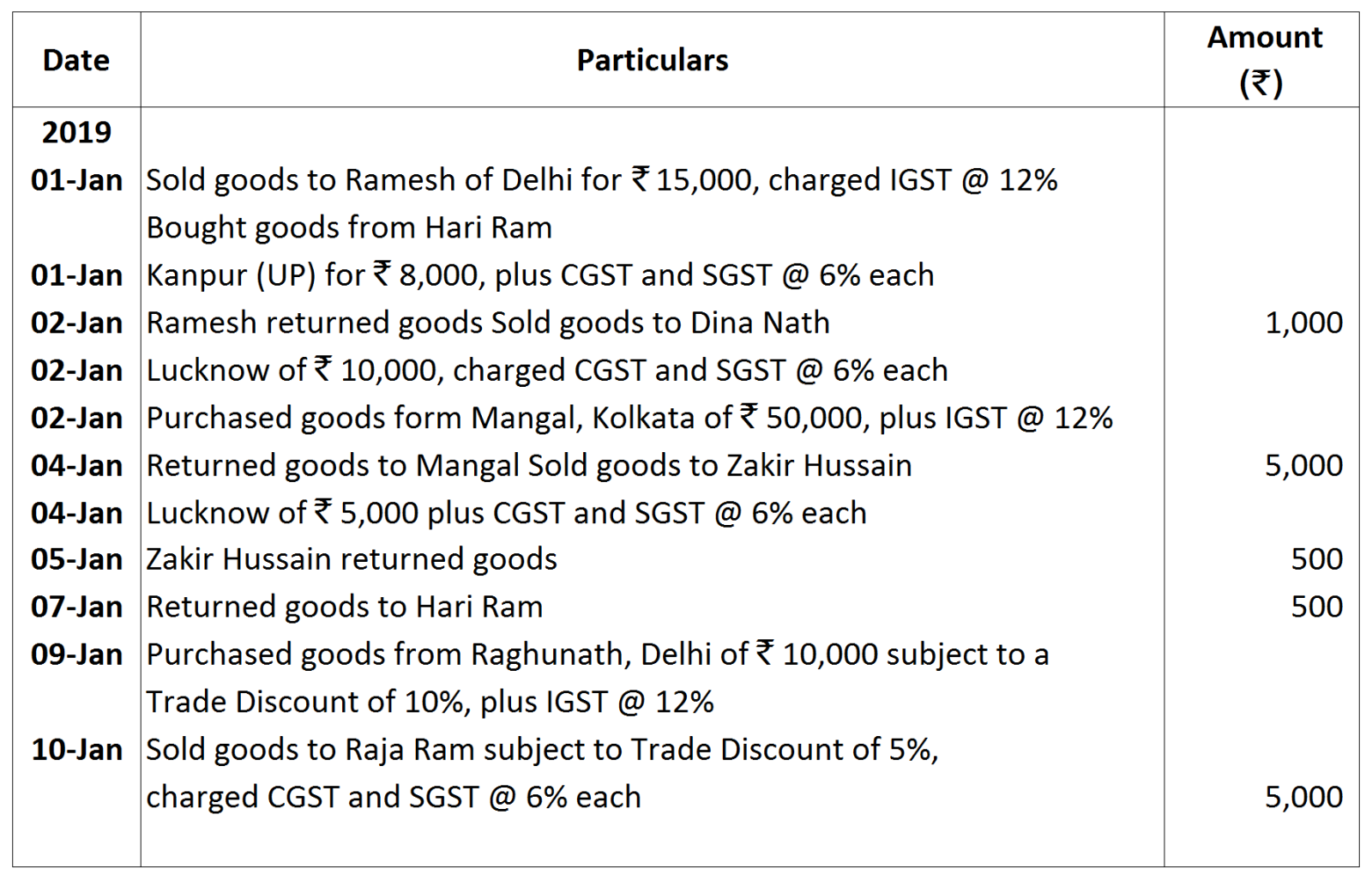
Enter the following transactions in proper Subsidiary Books of Ram, Lucknow (UP) for the month of January 2019:
On July 1, 2016 Pushpak Ltd. purchased a machinery for ₹ 5,70,000 and paid ₹ 30,000 for its overhauling and installation. Depreciation is provided @20% p.a. on Original Cost Method and the books are closed on 31st March every year. The machine was sold on 31st January 2019 for a sum of ₹ 1,60,000. You are required to show the Machinery Account and Provision for Depreciation Account for three years.
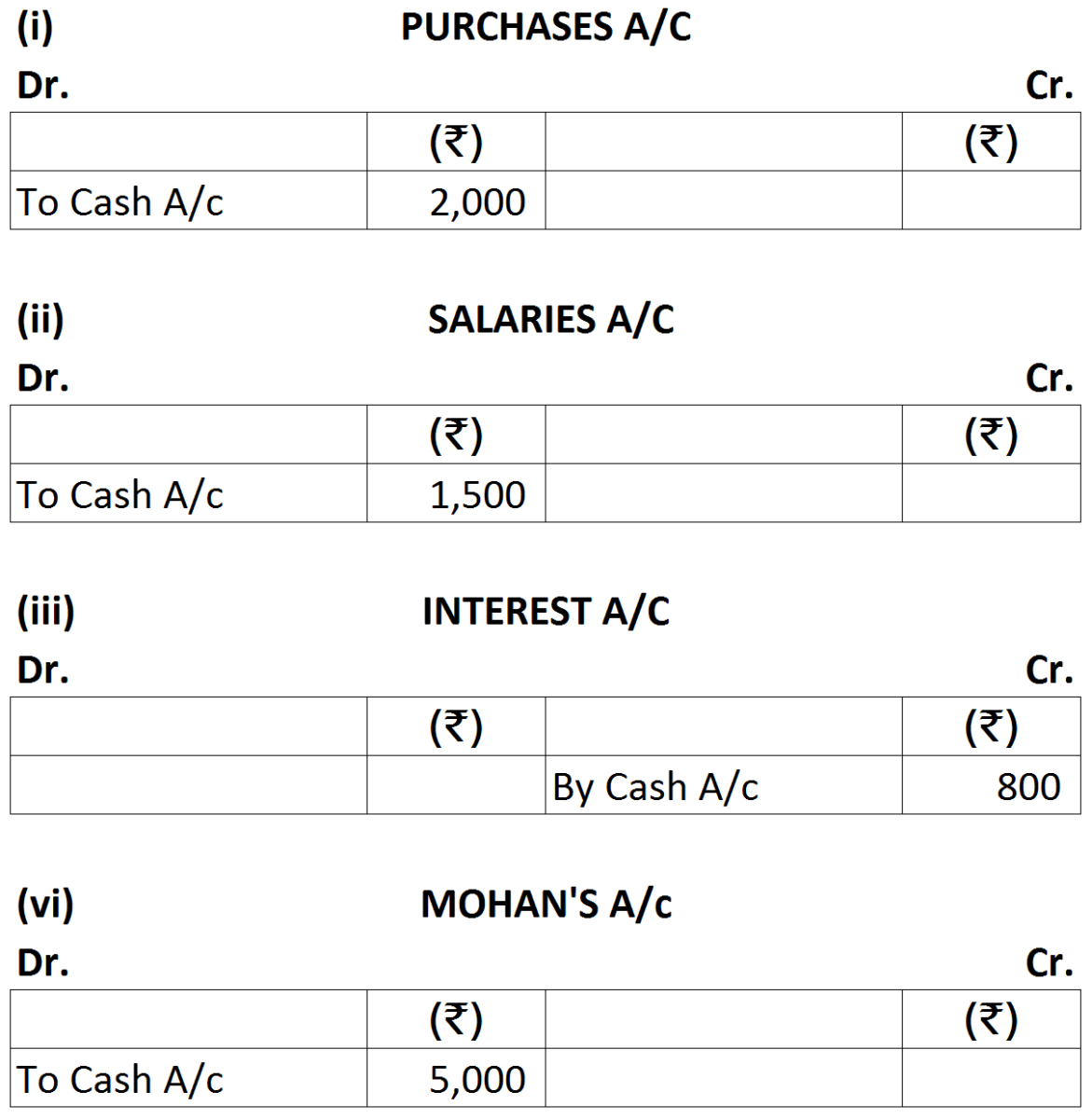
Prepare journal Entries of the following postings:
Prove that accounting equation is satisfied in all the following cases:
  1. Commenced business with cash ₹ 50,000.
  2. Paid rent ₹ 4,000 including ₹ 1,000 as advance.
  3. Bought goods for cash ₹ 30,000 and on credit ₹ 20,000.
  4. Sold the goods bought on credit for ₹ 25,000.
  5. Purchased furniture worth ₹ 10,000 for office use and for ₹ 5,000 for domestic use.
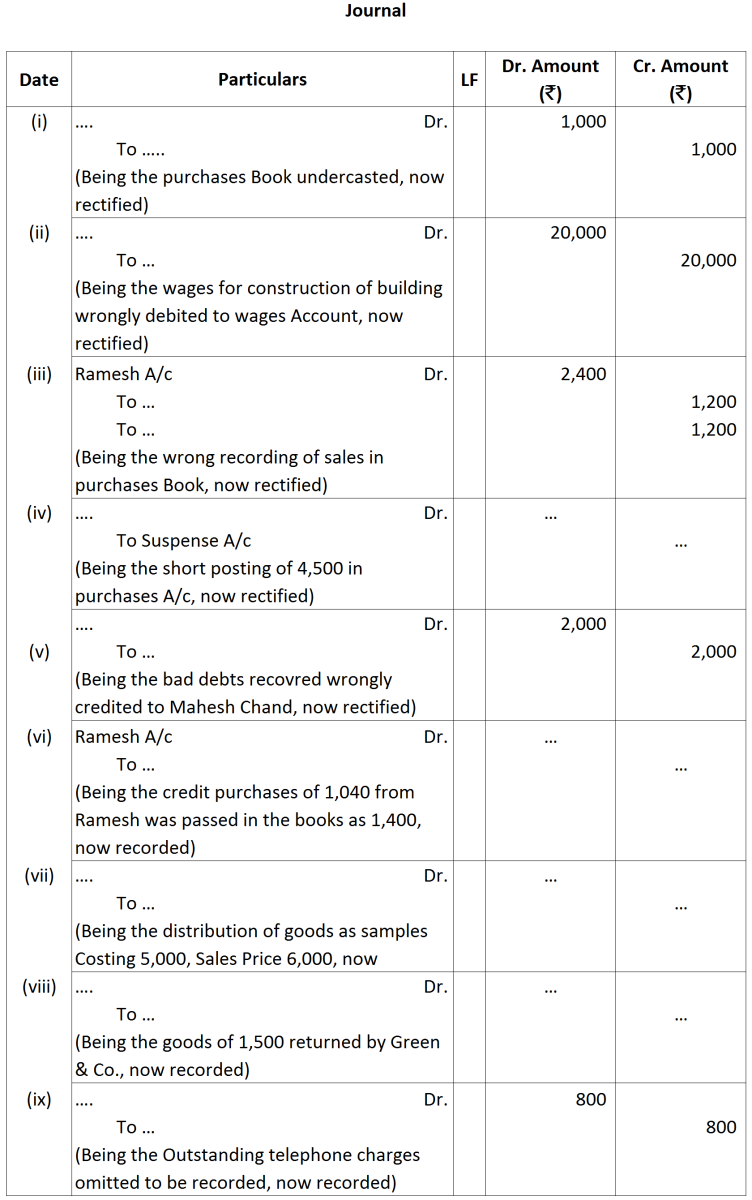
Determine the missing information in the following Rectifying Journal Entries:
Prepare an Accounting Equation and Balance Sheet on the following basis:
  1. Ajeet started business with cash ₹ 20,000.
  2. He purchased furniture for ₹ 2,000.
  3. He paid rent of ₹ 200.
  4. He purchase goods on credit ₹ 3,000.
  5. He sold goods (cost price ₹ 2,000) for ₹ 5,000 on cash.
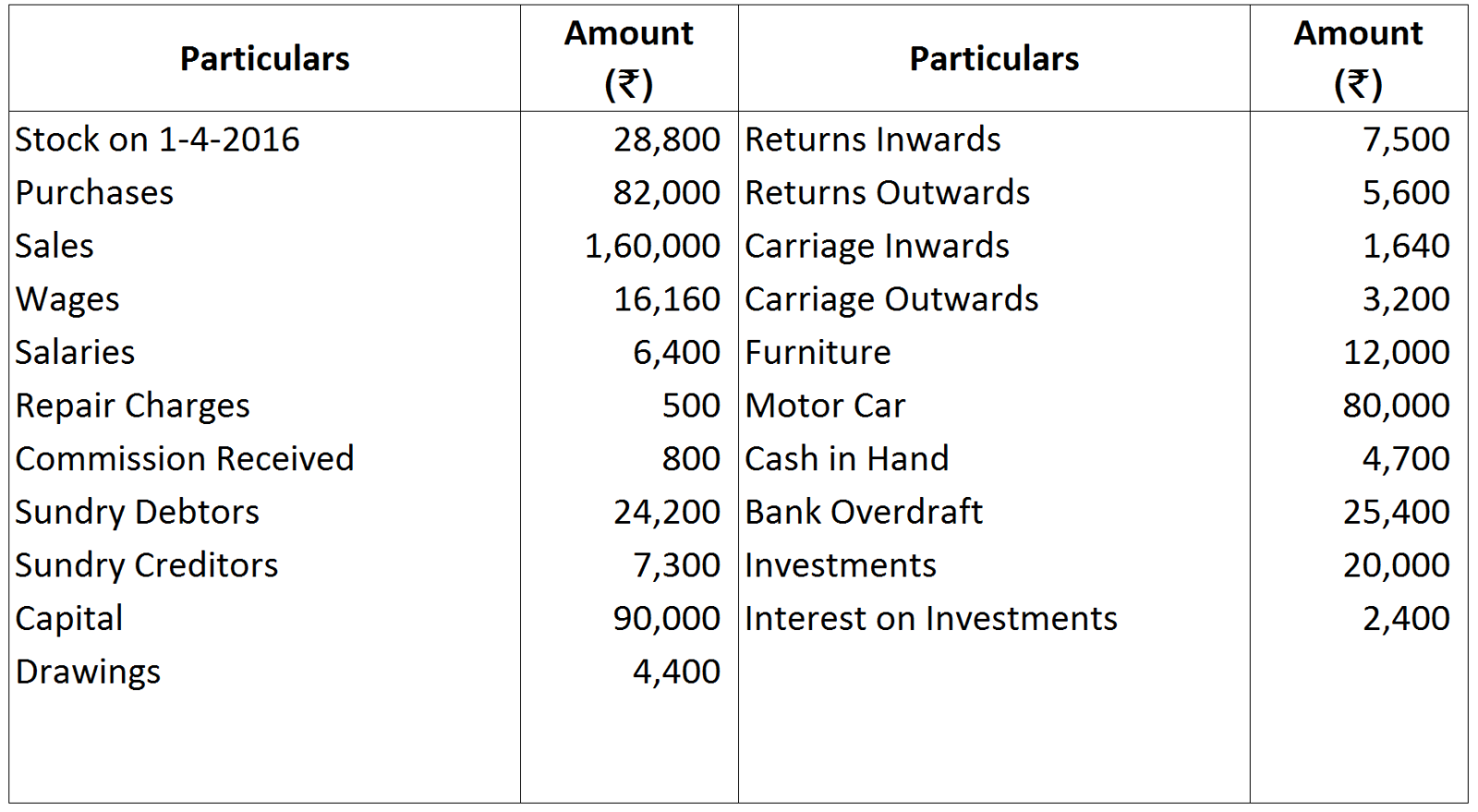
Prepare a Trial Balance from the following balances as at 31st March 2017:−
On 1st April, 2015, furniture costing ₹ 55,000 was purchased. It is estimated that its life is 10 years at the end of which it will be sold for ₹ 5,000. Additions are made on 1st April 2016 and 1st October, 2018 to the value of ₹ 9,500 and ₹ 8,400 (Residual values ₹ 500 and ₹ 400 respectively). Show the Furniture Account for the first four years, if Depreciation is written off according to the Straight Line Method.
Rectify the following errors:-
  1. A sale of goods to Raja Ram for ₹ 2,500 was passed through the Purchases Book.
  2. Salary of ₹ 800 paid to Hari Babu was wrongly debited to his personal account.
  3. Furniture purchased on credit from Mohan Singh for ₹ 1,000 was entered in the Purchases Book.
  4. ₹ 5,000 spent on the extension of buildings was debited to Buildings Repairs Account.
  5. Goods returned by Mani Ram ₹ 1,200 were entered in the Returns Outwards Book.