Question
Give the rules of VSEPR Theory.

Answer

Rules of VSEPR Theory:
i. Electron pairs arrange themselves in such a way that repulsion between them is minimum.
ii. The molecule acquires minimum energy and maximum stability.
iii. Lone pair of electrons also contribute in determining the shape of the molecule.
iv. Repulsion of other electron pairs by the lone pair (L.P.) stronger than that of bonding pair (B.P.).
Trend for repulsion between electron pair is as follows:
L.P. – L.P. > L.P. – B.P. > B.P. – B.P.
Lone pair-Lone pair repulsion is maximum because this electron pair is under the influence of only one nucleus while the bonded pair is shared between two nuclei.
Thus, the number of lone pair and bonded pair of electrons decide the shape of the molecules. Molecules having no lone pair of electrons have a regular geometry.

Note:
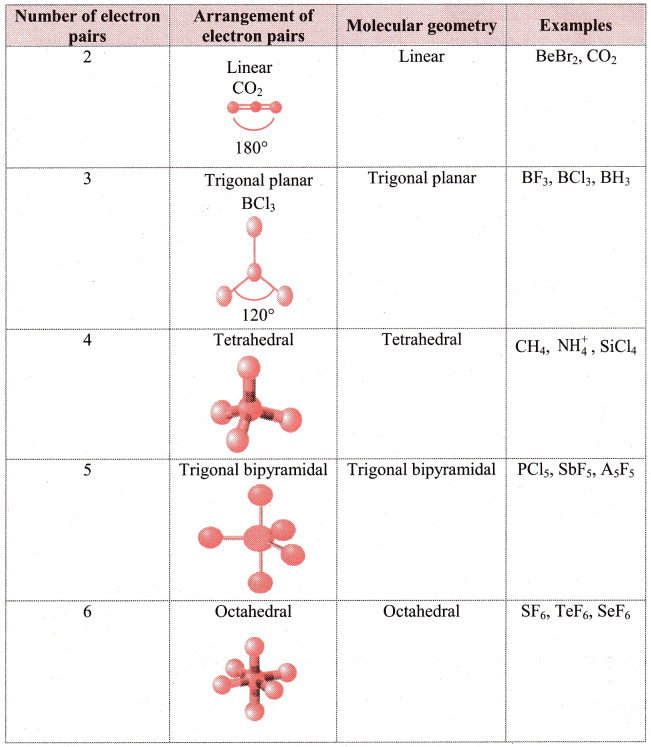
i. Electron pair geometry: The arrangement of electrons around the central atom is called as electron pair geometry. These electron pairs may be shared in a covalent bond or they may be lone pairs.
ii. Geometry of some molecules (having no lone pair of electrons):
Image

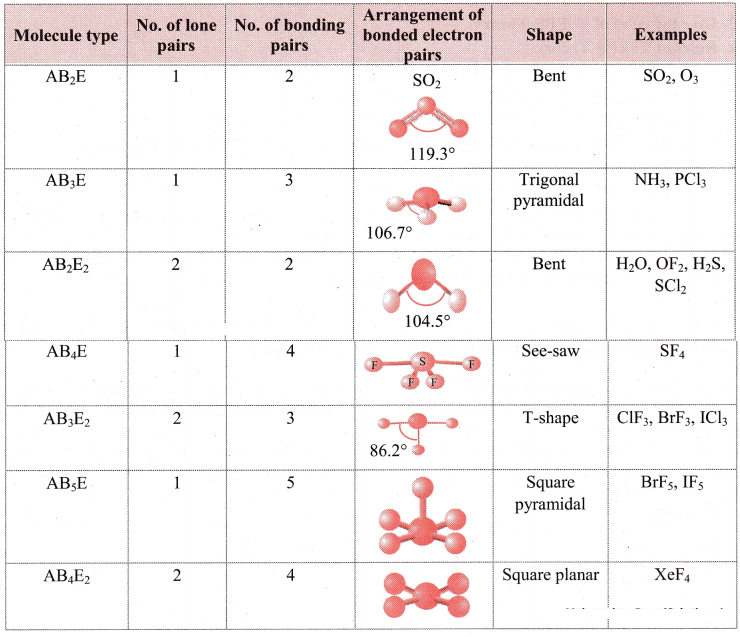
iii. Geometry of some molecules (having one or more lone pairs of electrons):
Image

Need a full question paper?

Generate a complete, print-ready paper with questions like this in minutes — across 16+ boards, with answer keys.

Start Generating Free

Similar questions

Describe the structure of graphite.
$6 g$ of $H_2$ reacts with $32 g$ of $O_2$ to yield water. Which is the limiting reactant? Find the mass of water produced and the amount of excess reagent left.
Calculate the molecular mass of the following in $: i.  H_2O \ \ \  ii. C_6H_5Cl \ \ \ iii. H_2SO_4$
Using oxidation number concept, identify the redox reactions, identify oxidizing and reducing agents in case of redox reactions.
Image
Draw the structures of following:
i. Curcumin
ii. Methyl salicylate
iii. Cinnamaldehyde
iv. Eugenol
v. Vitamin C
vi. Gallic acid
Explain the formation of the following molecules on the basis of $\text{MOT.}$ Also find the bond order.
$i. H_{2 } \ \ \ ii. Li_{2 } \ \ \ iii. N_{2 } \ \ \  iv. O_{2 } \ \ \ v. F_2$
Explain liquid$-$vapour equilibrium with an example.
Calculate the number of moles and molecules of ammonia $(NH_3)$ gas in a volume $67.2 \ dm^3$ of it measured at $STP.$
Explain with diagrams $: i. sp^3$ hybridization  $ii. sp^2$ hybridization  $iii. sp$ hybridization
In a chemical laboratory, Priyal was asked to isolate an organic compound from its aqueous solution. She added ethyl acetate to the given sample, separated the organic layer and kept it for evaporation. At the end of her practical, Priyal found few crystals in the beaker which she kept for evaporation. Answer the following questions:
i. In the above passage, which method was used by Priyal for separation? State its principle.
ii. Why do you think the organic compound dissolved in ethyl acetate?
iii. Illustrate the method of separation used in the passage with an example.