MCQ
Give the unit of work function.
- AElectron volt
- BJoule
- CHertz
- DWatt
Explanation:
One electron volt is the kinetic energy gained by an electron when it is accelerated through a potential difference of 1 volt.
Therefore, 1 eV = 1.602 × 10⁻¹⁹ J.
Generate a complete, print-ready paper with questions like this in minutes — across 16+ boards, with answer keys.
If the cathode–anode potential difference in an X-ray tube be 105 V, then the maximum energy of X-ray photon can be
| (a) 105 J | (b) 105 MeV | (c) 10–1 MeV | (d) 105 KeV |
The focal length of a convex mirror is 20 cm its radius of curvature will be
|
(a) 10 cm |
(b) 20 cm |
(c) 30 cm |
(d) 40 cm |
An electron and a proton are in a uniform electric field, the ratio of their accelerations will be
|
(a) Zero |
|
(b) Unity |
|
(c) The ratio of the masses of proton and electron |
|
(d) The ratio of the masses of electron and proton |
Assertion : Television signals are received through sky-wave propagation.
Reason : The ionosphere reflects electromagnetic waves of frequencies greater than a certain critical frequency.
|
(a) If both assertion and reason are true and the reason is the correct explanation of the assertion. |
|
(b) If both assertion and reason are true but reason is not the correct explanation of the assertion. |
|
(c) If assertion is true but reason is false. |
|
(d) If the assertion and reason both are false. |
According to Faraday's law of electromagnetic induction
|
(a) The direction of induced current is such that it opposes the cause producing it |
|
(b) The magnitude of induced e.m.f. produced in a coil is directly proportional to the rate of change of magnetic flux |
|
(c) The direction of induced e.m.f. is such that it opposes the cause producing it |
|
(d) None of the above |
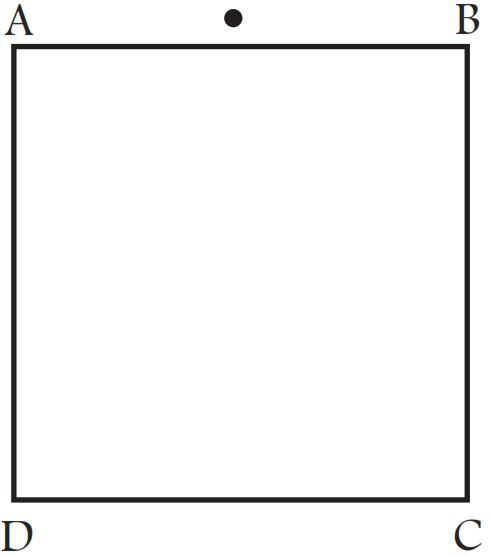
A rectangular block of glass ABCD has a refractive index 1.6. A pin is placed midway on the face AB (Fig). When observed from the face AD, the pin shall: