Question
  1. Give three points of difference between lanthanoids and actinoids.
  2. Give reason and select one atom$/$ion which will exhibit asked property:
  1. $Sc^{3+}$ or $Cr^{3+} ($Exhibit diamagnetic behaviour$).$
  2. $Cr$ or $Cu ($High melting and boiling point$).$
Answer

  1.  
S. No.
Lanthanoids
Actinoids
$1.$
Most of them are not radioactive.
All are radioactive.
$2.$
Don’t show a wide range of oxidation state.
Show a wide range of oxidation states.
$3.$
Most of their ions are colourless.
Most of their ions are coloured.
  1.  
  1. $Sc^{+3},$ because of absence of unpaired electron.
  2. $Cr,$ because of presence of strong intermetallic bonding than $Cu.$

Need a full question paper?

Generate a complete, print-ready paper with questions like this in minutes — across 16+ boards, with answer keys.

Start Generating Free

Similar questions

(i) Define the order of a reaction.
(ii) Explain the effect of concentration of reactant on the rate constant.
(iii) For a first order reaction, if the rate constant at 500 K and 600 K are $0.03 s^{-1}$ and $0.06 s^{-1}$ respectively, then calculate the activation energy.
$
\left[R=8.314 JK^{-1} mol^{-1}, \log 2=0.3010\right]
$
Describe the standard hydrogen electrode with diagram.
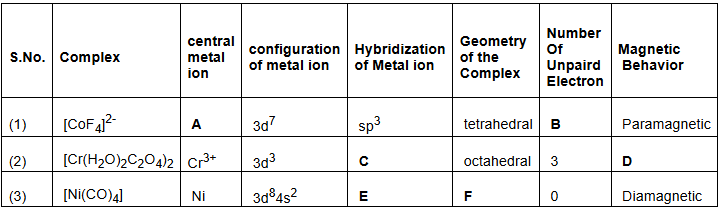
$(a).$ Using, Valence Bond Theory identify $\ce{A, B, C, D, E}$ and $\ce{F}$ in the following table$:$​​​​​​​
Image
$(b).$ Write the ionic equations for the reaction of acidified $\ce{K_2Cr_2O_7}$ with
$\ce{(i) H_2S}$ and $\ce{(ii) FeSO_4}​​​​​​​$​​​​​​​
  1. How are lipids classified? Give an example of each class.
  2. Explain the following terms:
  1. Mutarotation.
  2. Avitaminosis.
100 g of liquid A (molar mass 140 g mol-1) was dissolved in 1000 g of liquid B (molar mass 180 g mol-1). The vapour pressure of pure liquid B was found to be 500 Torr. Calculate the vapour pressure of pure liquid A and its vapour pressure in the solution if the total vapour pressure of the solution is 475 Torr.
  1. How is the variability in oxidation states of transition metals different from that of the $p-$block elements?
  2. Out of $Cu^+$ and $Cu^{2+}$, which ion is unstable in aqueous solution and why?
  3. Orange colour of $Cr_2O_7^{2–}$ ion changes to yellow when treated with an alkali. Why?
  4. Chemistry of actinoids is complicated as compared to lanthanoids. Give two reasons.
The experimental data for decomposition of N2O5
$\left[2 N_2 O _5 \rightarrow 4 NO _2+ O _2\right]$
in gas phase at 318 K are given below :
t/s$10^{-2} \times\left[ N _2 O _5\right] / mol L ^{-1}$
01.63
4001.36
8001.14
12000.93
16000.78
20000.64
24000.53
28000.43
32000.35

(i) Plot [N2O5] against t.
(ii) Find the half-life period for the reaction.
(iii) Draw a graph between log[N2O5] and t.
(iv) What is the rate law?
(v) Calculate the rate constant.
(iv) Calculate the half-life period from k and compare it with (ii).
Magnetic properties of coordination compounds. Explain in detail.
Match the items given in Column I with the type of solutions given in Column II.
 
Column I
 
Column II
i.
Soda water
a.
A solution of gas in solid.
ii.
Sugar solution
b.
A solution of gas in gas.
iii.
German silver
c.
A solution of solid in liquid.
iv.
Air
d.
A solution of solid in solid.
v.
Hydrogen gas in palladium
e.
A solution of gas in liquid.
 
 
f.
A solution of liquid in solid.
For the decomposition of azoisopropane to hexane and nitrogen at 543 K , the following data is obtained :
$t( sec )$$P$ (mm of Hg )
035.0
36054.0
72063.0

Calculate the rate constant.