Question
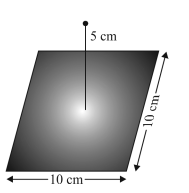
Given a uniformly charged plane/sheet of surface charge density, $\sigma=2\times10^{17}\text{C/m}^2.$Image
  1. Find the electric field intensity at a point A, 5mm away from the sheet on the left side.
  2. Given a straight line with three points X, Y and Z placed 50cm away from the charged sheet on the right side. At which of these points, the field due to the sheet remain the same as that of point A and why?
Answer

  1. At A, $\text{E}=\frac{\sigma}{2\epsilon_0}=\frac{2\times10^{17}\text{Cm}^{-2}}{2\times8.854\times10^{-12}\text{C}^2\text{N}^{-1}\text{m}^{-2}}$
$\text{E}=1.1\times1028 \text{N/C}$
Directed away from the sheet.
  1. Point Y, Because at 50cm, the charge sheet acts as a finite sheet and thus the magnitude remains same towards the middle region of the planar sheet.

Need a full question paper?

Generate a complete, print-ready paper with questions like this in minutes — across 16+ boards, with answer keys.

Start Generating Free

Similar questions

A small telescope has an objective lens of focal length 144 cm and an eyepiece of focal length 6.0 cm. What is the magnifying power of the telescope? What is the separation between the objective and the eyepiece?
Let AE denote the energy gap between the valence band and the conduction band. The population of conduction electrons (and of the holes) is roughly proportional to $\text{e}^{\frac{-\Delta\text{E}}{2\text{kT}}}.$ Find the ratio of the concentration of condu.ction electrons in diamond to that in silicon at room temperature 300K. $\Delta\text{E}$ for silicon is 1.1eV and for diamond is 6.0eV. How many conduction electrons are likely to be in one cubic metre of diamond?
A point charge +10 µC is at a of distance 5 cm directly above the centre of a square of side 10 cm, as shown in Fig. What is the magnitude of the electric flux through the square? (Hint: Think of the square as one face of a cube with edge 10 cm.)
Image
i. Differentiate between three segments of a transistor on the basis of their size and level of doping.
ii. When is a transistor said to be in active state?
iii. Draw a plot of transfer characteristic ($V _0$ vs. $V _{ i }$ ) and show which portion of the characteristic is used in amplification and why?
iv. Draw the circuit diagram of the base bias transistor amplifier in CE configuration and briefly explain its working.
A small flat search coil of area $5 \ cm^2$ with $140$ closely wound turns is placed between the poles of a powerful magnet producing magnetic field $0.09 T$ and then quickly removed out of the field region. Calculate
$a.$ change of magnetic flux through the coil, and
$b.$ emf induced in the coil.
Define the terms
$(i)$ 'cut$-$off voltage' and
$(ii)$ 'threshold frequency' in relation to the phenomenon of photoelectric effect.
Using Einstein's photoelectric equation show how the cut$-$off voltage and threshold frequency for a given photosensitive material can be determined with the help of a suitable plot/graph.
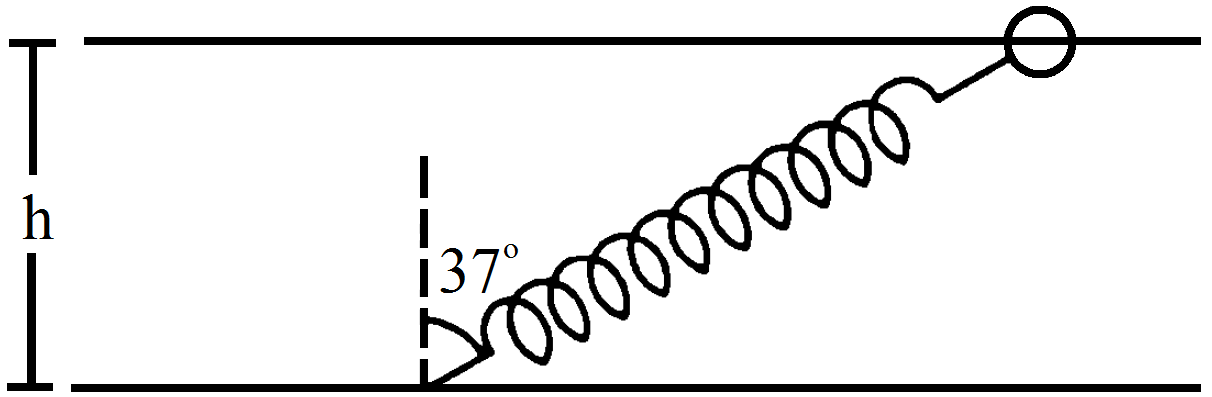
One end of a spring of natural length h and spring constant k is fixed at the ground and the other is fitted with a smooth ring of mass m which is allowed to slide on a horizontal rod fixed at a height h (figure). Initially, the spring makes an angle of 37° with the vertical when the system is released from rest. Find the speed of the ring when the spring becomes vertical.
A flywheel of moment of inertia $5.0\ kg-m^2$ is rotated at a speed of $60 \text{ rad/s.}$ Because of the friction at the axle, it comes to rest in $5.0$ minutes. Find:
  1. The average torque of the friction.
  2. The total work done by the friction.
  3. The angular momentum of the wheel 1 minute before it stops rotating.
Draw a labelled diagram of an a.c. generator. Explain briefly its principle and working.
An ideal gas expands from 100\ cm^3 to $200\ cm^3$ at a constant pressure of $2.0 \times 10^5$ Pa when $50J$ of heat is supplied to it. Calculate,