Question
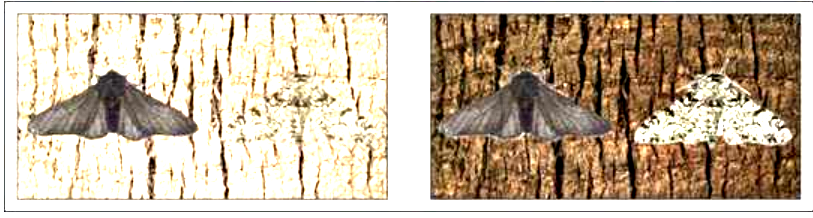
Given alongside are two figures (A and B) showing a phenomenon that was first observed in Manchester before and after the year 1850.

Briefly mention why the changes shown in the two figures appeared.

Answer

Reasons for changes in the two figures:
  • Before the Industrial Revolution, a thick growth of white-colouredlichen covered the trees. As a result, the light-coloured moths were camouflaged and survived under this cover, while the dark-coloured moths were easily spotted by predators.
  • After the Industrial Revolution, pollution resulted in a decline in the growth of lichens. The tree bark got exposed due to the absence of lichens. As a result, dark-colouredmoths now got an advantage of a dark background, were camouflaged and survived, while the light-coloured moths were easily picked by predators.
  • This showed that in a mixed population, those moths which could adapt to the changing environment after the Industrial Revolution survived and increased in number,while the ones which could not adapt were slowly wiped out from the population.

Need a full question paper?

Generate a complete, print-ready paper with questions like this in minutes — across 16+ boards, with answer keys.

Start Generating Free

Similar questions

The diagram alongside refers to an experiment in which the apparatus was set up with the light source 10 cm away from the plant. After 15 minutes the number of bubbles evolved per minute from the cut stem was recorded. The light source was moved to 20 cm away from the plant, left for 15 minutes and the number of bubbles evolved per minute was again recorded. The experiment was repeated with the light source at distances of 40, 60, 80 and 100 cm away from the plant. Plot a graph for the results obtained and answer the following questions.
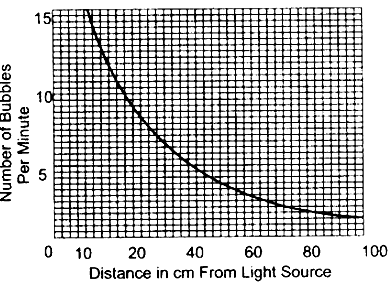
(i) From the graph it seems likely that the rate of bubbling per minute at 50 cm would have been
(a) 2.0 (b) 2.5 (c) 3.0 (d) 3.5
(ii) The gas produced by the plant during the experiment was
(a) air (b) oxygen (c) carbon dioxide (d) nitrogen (e) hydrogen
(iii) The gas collected comes due to the breakdown of
(a) glucose (b) starch (c) water (d) air (e) ATP
(iv) If ice cubes were added to the water, the rate of bubble formation would
(a) Stay the same.
(b) Increase because more water is added.
(c) Decrease because the temperature drops.
(d) Decrease because water freezes.
(e) Cannot tell from the information given.
(v) If some sodium bicarbonate is added to the water the rate of bubble formation
(a) Increases because more respiration occurs.
(b) Increases because more photosynthesis occurs.
(c) Increases because the gas becomes less soluble.
(d) Decreases because carbon dioxide acts as a limiting factor.
(e) Decreases because respiration decreases.
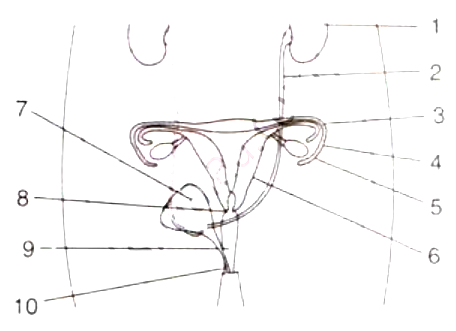
Given below is a diagram of two systems together in the human body.
Name the parts numbered 1-10.
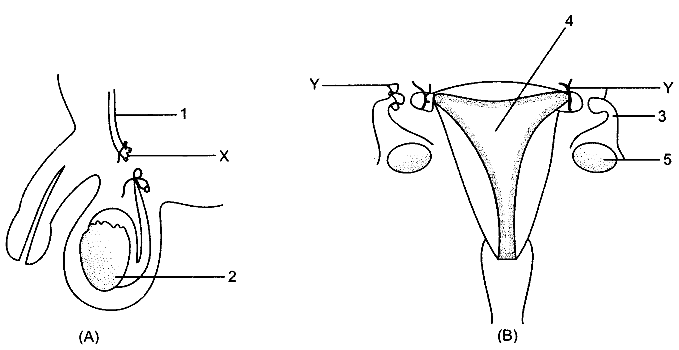
Observe the diagram A and B given below:
  • Label parts 1 – 5.
  • What does diagram A depict?
  • What does diagram B depict?
  • What comment on X and Y.
  • State one function each of part 2 and 4.
  • Distinguish between the following pair of words:
    Myopia and hypermetropia
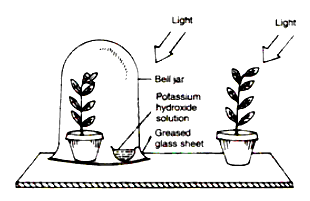
    Two healthy green plants were placed in the dark for $24$ hours. They were then set up, as shown in the figure, for $4$ hours. Then a leaf was taken from each plant and
    the chlorophyll was removed from the leaves:
    ( i) What is the next and final step in this experiment?
    ( ii ) What would be the results of the final step?
    ( iii ) Why was it necessary to grease the glass sheet?
    ( iv ) What hypothesis is being tested in this experiment?
    Describe the structural differences between an artery and a vein.
    Give reason for the following:
    The blood groups of both the donor and recipient must be known before transfusing blood.
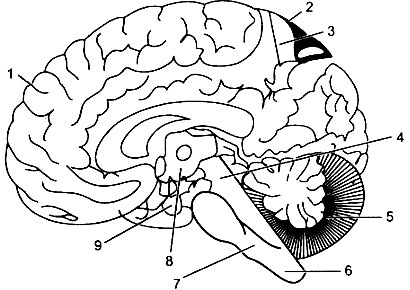
    The below diagram represents a longitudinal section of the human brain. Label its parts 1-9 as shown with guidelines.

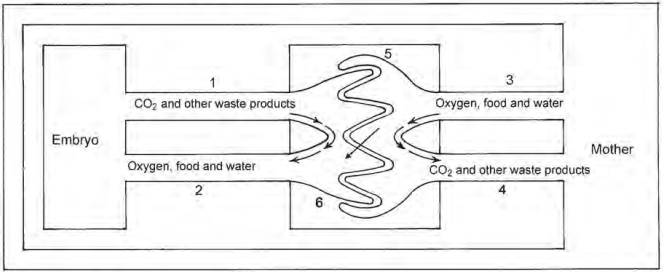
    The diagram shows the structure of part of a human placenta.
    (i) Name the structures labelled $1-6$.
    (ii) What substances diffuse into the placenta and what diffuse out of it?
    (iii) What are the functions of placenta?

    Image