Question
Given below are some examples of wave motion. State in each case if the motion is transverse, longitudinal or a combination of both.
  1. Motion of a kink in a long coil spring produced by displacing one end of the spring sideways.
  2. Wave produced in a cylinder containing water by moving its piston back and forth.
  3. Wave produced by a motorboat sailing in water.
  4. Ultrasonic waves in air produced by a vibrating crystal.
Answer

  1. Longitudinal wave.
  2. Transverse wave.
  3. Combination of both.
  4. Longitudinal wave.

Need a full question paper?

Generate a complete, print-ready paper with questions like this in minutes — across 16+ boards, with answer keys.

Start Generating Free

Similar questions

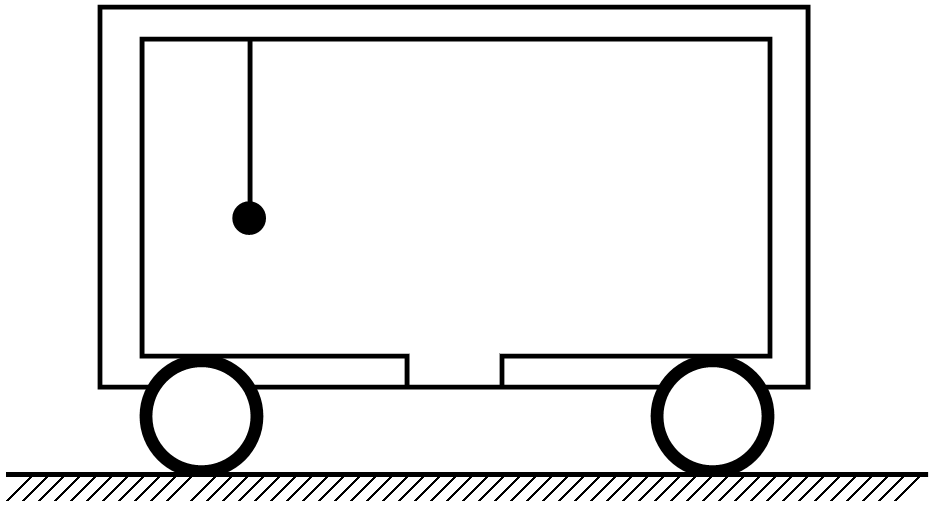
A cart of mass M is at rest on a frictionless horizontal surface and a pendulum bob of mass m hangs from the roof of the cart. The string breaks, the bob falls on the floor, makes several collisions on the floor and finally lands up in a small slot made in the floor. The horizontal distance between the string and the slot is L. Find the displacement of the cart during this process.

The temperature and relative humidity in a room are 300K and 20% respectively. The volume of the room is 50m3. The saturation vapour pressure at 300K is 3.3kPa. Calculate the mass of the water vapour present in the room.
Compute the fractional change in volume of a glass slab, when subjected to a hydraulic pressure of 10 atm.
The centre of mass is defined as $\overrightarrow{\text{R}}=\frac{1}{\text{M}}\sum\limits_\text{i}\text{m}_\text{i}\overrightarrow{\text{r}_{\text{i}}}.$ Suppose we define "centre of charge" as $\overrightarrow{\text{R}}_\text{c}=\frac{1}{\text{Q}}\sum\limits_\text{i}\text{q}_\text{i}\overrightarrow{\text{r}_{\text{i}}}$ where qi represents the ith charge placed at $\overrightarrow{\text{r}_\text{i}}$ and Q is the total charge of the system.
  1. Can the centre of charge of a two-charge system be outside the line segment joining the charges?
  2. If all the charges of a system are in X-Y plane, is it necessary that the centre of charge be in X-Y plane?
  3. If all the charges of a system lie in a cube, is it necessary that the centre of charge be in the cube?
Eight rain drops of radius 1 mm each falling down with terminal velocity of $5 cms ^{-1}$ coalesce to form a bigger drop. Find the terminal velocity of the bigger drop.
In a pure semiconductor, the number of conduction electrons is 6 × 10¹⁹ per cubic metre. How many holes are there in a sample of size 1cm × 1cm × 1mm?
State with reasons, whether the following algebraic operations with scalar and vector physical quantities are meaningful :
(a) adding any two scalars, (b) adding a scalar to a vector of the same dimensions, (c) multiplying any vector by any scalar, (d) multiplying any two scalars, (e) adding any two vectors, (f) adding a component of a vector to the same vector.
Prove that the elastic potential energy density of a stretched wire is equal to half the product of stress and strain.
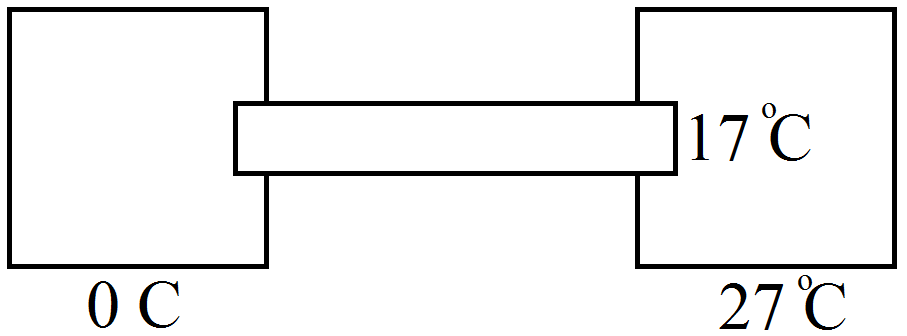
A cylindrical rod of length 50cm and cross sectional area 1cm2 is fitted between a large ice chamber at 0°C and an evacuated chamber maintained at 27°C as shown in figure. Only small portions of the rod are inside the chambers and the rest is thermally insulated from the surrounding. The cross section going into the evacuated chamber is blackened so that it completely absorbs any radiation falling on it. The temperature of the blackened end is 17°C when steady state is reached. Stefan constant $\sigma=6\times10^{-8}\text{W/m}^{-2}\text{K}^{-4}.$ Find the thermal conductivity of the material of the rod.

A semicircular wire has a length L and mass M.A particle of mass m is placed at the centre of the circle. Find the gravitational attraction on the particle due to the wire.