Question
Given below are the events that are observed in artificial hybridisation programme. Arrange them in the correct sequential order in which they are followed in the hybridisation programme.
(a) Re-bagging; (b) Selection of parents; (c) Bagging; (d) Dusting the pollen on stigma; (e) Emasculation; (f) Collection of pollen from male parent.

Answer

(b) Selection of parents; (e) Emasculation; (c) Bagging; (f) Collection of pollen from male parent; (d) Dusting the pollen on stigma; (a) Re-bagging.

Need a full question paper?

Generate a complete, print-ready paper with questions like this in minutes — across 16+ boards, with answer keys.

Start Generating Free

Similar questions

In a Mendelian monohybrid cross, the $F_2$ generation shows identical genotypic and phenotypic ratios.
​​​​​​​What does it tell us about the nature of alleles involved?
Justify your answer.
What is LAB? What is its role in human stomach?
Is it possible to consider vegetative propagation observed in certain plants like Bryophyllum, water hyacinth, ginger etc., as a type of asexual reproduction? Give two/ three reasons.
Highlight the differences between the population interactions given below. Give an example of each.
  1. Parasitism.
  2. Amensalism.
  3. Mutualism.
Describe the structure of RNA polynucleotide chain having four different types of nucleotides.
  1. Identify the polarity from a to a', in the above diagram and mention how many more amino acids are expected to be added to this polypeptide chain.
  2. Mention the DNA sequence coding for serine and the anticodon of tRNA for the same amino acid.
  3. Why are some untranslated sequence of bases seen in mRNA coding for a polypeptide? Where exactly are they present on mRNA?
  1. What is activated sludge? How is it produced?
  2. State some uses of biogas.
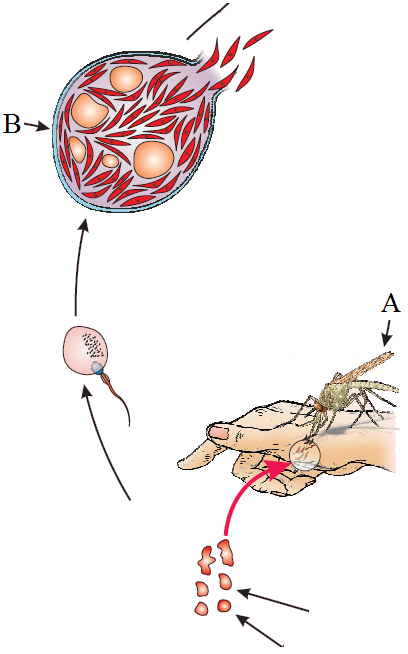
Study a part of the life cycle of malarial parasite given below. Answer the questions that follow:
  1. Mention the roles of 'A' in the life cycle of the malarial parasite.
  2. Name the event 'C' and the organ where this event occurs.
  3. Identify the organ 'B' and name the cells being released from it.
Enlist any six categories into which a given species is placed once it has been thoroughly evaluated by IUCN.
What are the major causes of species losses in a geographical region?