MCQ
Given below are two statements: one is labelled as Assertion $(A)$ and the other is labelled as Reason $(R)$. Assertion $(A)$ : In aqueous solutions $\mathrm{Cr}^{2+}$ is reducing while $\mathrm{Mn}^{3+}$ is oxidising in nature.

Reason $(R)$ : Extra stability to half filled electronic configuration is observed than incompletely filled electronic configuration.

In the light of the above statement, choose the most appropriate answer from the options given below:

  •  Both $(A)$ and $(R)$ are true and $(R)$ is the correct explanation of $(A)$
  • B
    Both $(A)$ and $(R)$ are true but $(R)$ is not the correct explanation of $(A)$
  • C
    $(A)$ is false but $(R)$ is true
  • D
    $(A)$ is true but $(R)$ is false

Answer

Correct option: A.
 Both $(A)$ and $(R)$ are true and $(R)$ is the correct explanation of $(A)$
a
$\mathrm{Cr}^{2+}$ is reducing as it configuration changes from $\mathrm{d}^4$ to $\mathrm{d}^3$ due to formation of $\mathrm{Cr}^{3+}$, which has half filled $\mathrm{t}_{2 \mathrm{~g}}$ level, on other hand, the change $\mathrm{Mn}^{3+}$ to $\mathrm{Mn}^{2+}$ result half filled $d^3$ configuration which has extra stability.

Need a full question paper?

Generate a complete, print-ready paper with questions like this in minutes — across 16+ boards, with answer keys.

Start Generating Free

Similar questions

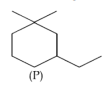
IUPAC name of following compound (P) is :

 Image
An ideal gas undergoes isothermal compression from $5\, m^3$ to $1\, m^3$ against a constant external pressure of $4\, Nm^{-2}$. Heat released in this process is used to increase the temperature of $1\, mole$ of $Al$. If molar heat capacity of $Al$ is $24\, J\, mol^{-1}\,K^{-1}$, the temperature of $Al$ is increases by
Which one has the highest osmotic pressure
The compound($s$) which generate($s$) $\mathrm{N}_2$ gas upon thermal decomposition below $300^{\circ} \mathrm{C}$ is (are)

$(A)$ $\mathrm{NH}_4 \mathrm{NO}_3$   $(B)$ $\left(\mathrm{NH}_4\right)_2 \mathrm{Cr}_2 \mathrm{O}_7$   $(C)$ $\mathrm{Ba}\left(\mathrm{N}_3\right)_2$  $(D)$ $\mathrm{Mg}_3 \mathrm{~N}_2$

Standard electrode potentials are given

$A^+/A = \,-\,2.93\, Volt$,        $B^+/B = 0.80\,V$

$C^{+2}/C = \,-\,2.37\, Volt$,     $D^{+3}/D = \,-\,0.74\,V$

Increasing order of reducing power of these metals

$'C - C'$ bond length in benzene lies between single and double bond. The reason is
Which of the following metal is highest electropositive (metallic) in nature ?
Chlorine undergoes disproportionation in alkaline medium as shown below :

$ \text { a } \mathrm{Cl}_2(\mathrm{~g})+\mathrm{b} \mathrm{OH}^{-}(\mathrm{aq}) \rightarrow \mathrm{c} \mathrm{ClO}^{-}(\mathrm{aq})+\mathrm{d} \mathrm{Cl}^{-}(\mathrm{aq})  +\mathrm{e} \mathrm{H}_2 \mathrm{O}(l)$

The values of $a, \ b,\  c$ and $d$ in a balanced redox reaction are respectively :

Which of the following interaction lies in the range of $8 - 42\, kJ/mol$ ?
Propanal on treatment with dilute sodium hydroxide forms