MCQ
Given below are two statements: one is labelled as Assertion $(A)$ and the other is labelled as Reason $(R).$

Assertion $(A):$ Synthesis of ethyl phenyl ether may be achieved by Williamson synthesis.

Reason $(R):$ Reaction of bromobenzene with sodium ethoxide yields ethyl phenyl ether.

In the light of the above statements, choose the most appropriate answer from the options given below:

  • A
    Both $(A)$ and $(R)$ are correct and $(R)$ is the correct explanation of $(A)$
  • $(A)$ is correct but $(R)$ is not correct
  • C
    $(A)$ is not correct but $(R)$ is correct
  • D
    Both $(A)$ and $(R)$ are correct but $(R)$ is NOT the correct explanation of $(A)$

Answer

Correct option: B.
$(A)$ is correct but $(R)$ is not correct
b

Need a full question paper?

Generate a complete, print-ready paper with questions like this in minutes — across 16+ boards, with answer keys.

Start Generating Free

Similar questions

The wavelength of the electron emitted by a metal sheet of work function $4\,eV$ when photons from $EMR$ of wavelength $124\,nm$ strike the metal plate ........... $\mathrm{nm}$
Which of the following organic compounds has same hybridization as its combustion product $(CO_2)\,?$
Which type of bond is formed between similar atoms
The number of electrons that are paired in oxygen molecule is
Standard electrode potential for $Sn^{4+}/Sn^{2+}$ couple is $+ 0.15\, V$ and that for the $Cr^{3+} /Cr$ couple is $- 0.74\, V.$ These two couples in theirstandard state are connected to make a cell.The cell potential will be ........ $V$
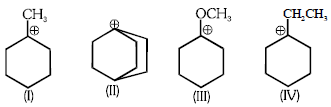
Which of the following carbocation is least stable
$\begin{gathered}
  \begin{array}{*{20}{c}}
  {O\,\,\,\,\,\,\,\,\,\,\,\,\,\,\,\,\,\,\,\,\,\,\,\,\,\,\,\,\,\,\,\,\,\,\,\,\,\,\,\,\,\,\,\,\,\,\,\,\,\,\,\,\,\,\,\,\,\,\,\,\,\,\,\,\,\,\,\,\,\,\,\,\,\,} \\ 
  {||\,\,\,\,\,\,\,\,\,\,\,\,\,\,\,\,\,\,\,\,\,\,\,\,\,\,\,\,\,\,\,\,\,\,\,\,\,\,\,\,\,\,\,\,\,\,\,\,\,\,\,\,\,\,\,\,\,\,\,\,\,\,\,\,\,\,\,\,\,\,\,\,\,\,} \\ 
  {C{H_3} - {\text{  }}C - {\text{ }}O - H\xrightarrow{{NaH{{\mathop {CO}\limits^{14} }_3}}}\mathop {(A)}\limits_{(gas)} \xrightarrow[{(ii){H_3}{O^ \oplus }}]{{(i)PhMgBr}}(B)} 
\end{array} \hfill \\
  \begin{array}{*{20}{c}}
  {O\,\,\,\,\,\,\,\,\,\,\,\,\,\,\,\,\,\,\,\,\,\,\,\,\,\,\,\,\,\,\,\,\,\,\,\,\,\,\,\,\,\,\,\,\,\,\,\,\,\,\,\,\,\,\,\,\,\,\,\,\,\,\,\,\,\,\,\,\,\,\,\,\,\,} \\ 
  {||\,\,\,\,\,\,\,\,\,\,\,\,\,\,\,\,\,\,\,\,\,\,\,\,\,\,\,\,\,\,\,\,\,\,\,\,\,\,\,\,\,\,\,\,\,\,\,\,\,\,\,\,\,\,\,\,\,\,\,\,\,\,\,\,\,\,\,\,\,\,\,\,\,\,} \\ 
  {C{H_3} - S - O - H\xrightarrow{{NaH\mathop {C{O_3}}\limits^{14} }}\mathop {(C)}\limits_{(gas)} \xrightarrow[{(ii){H_3}{O^ \oplus }}]{{(i)PhMgBr}}(D)} \\ 
  {||\,\,\,\,\,\,\,\,\,\,\,\,\,\,\,\,\,\,\,\,\,\,\,\,\,\,\,\,\,\,\,\,\,\,\,\,\,\,\,\,\,\,\,\,\,\,\,\,\,\,\,\,\,\,\,\,\,\,\,\,\,\,\,\,\,\,\,\,\,\,\,\,\,\,\,} \\ 
  {O\,\,\,\,\,\,\,\,\,\,\,\,\,\,\,\,\,\,\,\,\,\,\,\,\,\,\,\,\,\,\,\,\,\,\,\,\,\,\,\,\,\,\,\,\,\,\,\,\,\,\,\,\,\,\,\,\,\,\,\,\,\,\,\,\,\,\,\,\,\,\,\,\,\,\,\,} 
\end{array} \hfill \\ 
\end{gathered}$

Product $(B)$ and $(D) $ in the above reaction are

Which expression is correct for the work done in adiabatic reversible expansion of an ideal gas
The oxidation state of $I$ in ${H_4}IO_6^ - $ is
Arrange the following in correct order of stability