MCQ
Given below are two statements: One is labelled as Assertion A and the other is labelled as Reason $R$

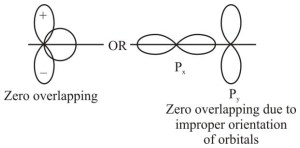
Assertion $A$ : Zero orbital overlap is an out of phase overlap.

Reason $R$ : It results due to different orientation/ direction of approach of orbitals.

In the light of the above statements. Choose the correct answer from the options given below.

  • Both $A$ and $R$ are true and $R$ is the correct explanation of $A$
  • B
    Both $A$ and $R$ are true but $R$ is $NOT$ the correct explanation of $A$
  • C
    $A$ is true but $R$ is false
  • D
    $A$ is false but $R$ is true

Answer

Correct option: A.
Both $A$ and $R$ are true and $R$ is the correct explanation of $A$
a

Need a full question paper?

Generate a complete, print-ready paper with questions like this in minutes — across 16+ boards, with answer keys.

Start Generating Free

Similar questions

Volume of $0.6\,\, M\,\, NaOH$ required to neutralize $30\,c{m^3}$ of $0.4\,\, M\,\, HCl$ is ............. $\mathrm{cm}^{3}$
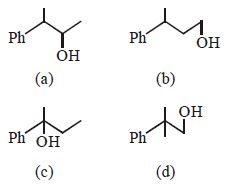
The relative rate of acid catalysed dehydration of following alcohols would be
The major product of the following reaction is
The standard heat of formation $\left(\Delta_{t} \mathrm{H}_{298}^{0}\right)$ of ethane in $(kJ/mol)$, if the heat of combustion of ethane, hydrogen and graphite are $-1560$, $-393.5$ and $-286 \;\mathrm{kJ} / \mathrm{mol},$ respectively is ........... $\mathrm{kJ/mol}$
Consider the following cell reaction

$2Fe(s)\, + \,{O_2}\,(g)\, + \,4{H^ + }(aq)\, \to \,2F{e^{2 + }}(aq) + 2{H_2}O(l)\,;$   $E^o =1.67\,V$

At $[Fe^{2+}] = 10^{-3}\, M$, $p(O_2) = 0.1\,atm$ and $pH = 3$, the cell potential at $25\,^oC$ is .............. $\mathrm{V}$

Regarding $F^-$ and $Cl^-$ which of the following statements is/are correct ?

$(i)\,\, Cl^-$ can give up an electron more easily than $F^-$

$(ii) \,\,Cl^-$ is a better reducing agent than $F^-$

$(iii)\,\, Cl^-$ is smaller in size than $F^-$

$(iv)\,\, F^-$ can be oxidized more readily than $Cl^-$

For 'invert sugar', the correct statement(s) is(are)

(Given: specific rotations of ($+$)-sucrose, ($+$)-maltose, $L$-($-$)-glucose anc. $+(+)$-fructose in aqueous solution are $+66^{\circ},+140^{\circ},-52^{\circ}$ and $+92^{\circ}$, respectively)

($A$) 'invert sugar' is prepared by acid catalyzed hydrolysis of maltose

($B$) . 'invert sugar' is an equimolar mixture of $D$-($+$)-glucose and $D$-($-$)-fructose

($C$) specific rotation of 'invert sugar' is $-20^{\circ}$

($D$) on reaction with $\mathrm{Br}_2$ water, 'invert sugar' forms saccharic acid as one of the products

Nitrobenzene can be prepared from benzene by using a mixture of conc. $HN{O_3}$ and conc. ${H_2}S{O_4}.$ In the nitrating mixture, $HN{O_3}$ acts as a
Which of the following doesn't exist
If $M^{+3}$ has configuration $[Ar]3d^{10}$ then $M$ belongs to :-