MCQ
Given below are two statements : one is labelled as Assertion A and the other is labelled as Reason R.
Assertion A : The Bohr model is applicable to hydrogen and hydrogen-like atoms only.
Reason R : The formulation of Bohr model does not include repulsive force between electrons.
In the light of the above statements, choose the correct answer from the options given below :
  • A
    Both $\mathbf{A}$ and $\mathbf{R}$ are true but $\mathbf{R}$ is NOT the correct explanation of $\mathbf{A}$.
  • B
    $\mathbf{A}$ is false but $\mathbf{R}$ is true.
  • C
    Both $\mathbf{A}$ and $\mathbf{R}$ are true and $\mathbf{R}$ is the correct explanation of $\mathbf{A}$.
  • D
    $\mathbf{A}$ is true but $\mathbf{R}$ is false.
Answer

C. Both $\mathbf{A}$ and $\mathbf{R}$ are true and $\mathbf{R}$ is the correct explanation of $\mathbf{A}$.
Conceptual

Need a full question paper?

Generate a complete, print-ready paper with questions like this in minutes — across 16+ boards, with answer keys.

Start Generating Free

Similar questions

The focal lengths of the objective and eye-piece of a telescope are respectively $100 cm$ and $ 2 cm.$ The moon subtends an angle of ${0.5^o}\,$at the eye. If it is looked through the telescope, the angle subtended by the moon's image will be......$^o$
An electron is allowed to move with constant velocity along the axis of current carrying straight solenoid.

$A.$ The electron will experience magnetic force along the axis of the solenoid.

$B.$ The electron will not experience magnetic force.

$C.$ The electron will continue to move along the axis of the solenoid.

$D.$ The electron will be accelerated along the axis of the solenoid.

$E.$ The electron will follow parabolic path-inside the solenoid.

Choose the correct answer from the options given below:

When sunlight falls normally on earth, a luminous flux of $1.57 \times {10^5}\;lumen/{m^2}$ is produced on earth. The distance of earth from sun is $1.5 \times {10^8}Km$. The luminous intensity of sun in candela will be
When yellow light is incident on a surface, no electrons are emitted while green light can emit. If red light is incident on the surface, then
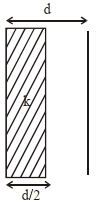
In a parallel plate capacitor set up, the plate area of capacitor is $2 \,m ^{2}$ and the plates are separated by $1\, m$. If the space between the plates are filled with a dielectric material of thickness $0.5\, m$ and area $2\, m ^{2}$ (see $fig.$) the capacitance of the set-up will be $.........\, \varepsilon_{0}$

(Dielectric constant of the material $=3.2$ ) and (Round off to the Nearest Integer)

The frequency and the intensity of a beam of light falling on the surface of photoelectric material are increased by a factor of two. This will :
Plane microwaves from a transmitter are directed normally towards a plane reflector. $A$ detector moves along the normal to the reflector. Between positions of $14$ successive maxima, the detector travels a distance $0.13\, m$. If the velocity of light is $3 \times 10^8 m/s$, find the frequency of the transmitter.
Two point charges $Q$ and $-3Q$ are placed at some distance apart. If the electric field at the location of $Q$ is $E$ then at the locality of $ - 3Q$, it is
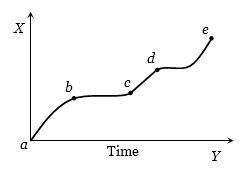
The displacement versus time graph for a body moving in a straight line is shown in figure. Which of the following regions represents the motion when no force is acting on the body
Light of wavelength $1824 Å$, incident on the surface of a metal, produces photo-electrons with maximum energy $5.3 eV.$ When light of wavelength $1216 Å$ is used, the maximum energy of photoelectrons is $8.7 eV$. The work function of the metal surface is .............. $eV$