MCQ
Given below are two statements : one is labelled as Assertion (A) and the other is labelled as Reason (R)
Assertion (A) : Refractive index of glass is higher than that of air.
Reason (R) : Optical density of a medium is directly proportionate to its mass density which results in a proportionate refractive index.
In the light of the above statements, choose the most appropriate answer from the options given below :
  • A
    (A) is not correct but (R) is correct
  • B
    Both (A) and (R) are correct and (R) is the correct explanation of (A)
  • C
    (A) is correct but (R) is not correct
  • D
    Both (A) and (R) are correct but (R) is not the correct explanation of (A)
Answer

C. (A) is correct but (R) is not correct
Refractive index has no relation with mass density because both have different meaning. Hence reason is incorrect.
So (A) is correct but (R) is not correct.

Need a full question paper?

Generate a complete, print-ready paper with questions like this in minutes — across 16+ boards, with answer keys.

Start Generating Free

Similar questions

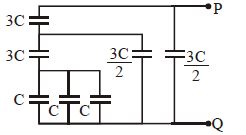
The value of equivalent capacitance of the combination shown in figure between the points $P$ and $Q$ is
A solid cylinder of mass $M$ and radius $R$ rolls down an inclined plane of height $h$. The angular velocity of the cylinder when it reaches the bottom of the plane will be
A point source of light is placed on the principle axis between $F$ and $2\, F$ of a concave lens. On the other side very far, a screen is placed perpendicular to principal axis. As the screen is brought close towards lens
A motor cycle driver doubles its velocity when he is having a turn. The force exerted outwardly will be
A projectile is fired with a velocity at right angle to the slope which is inclined at an angle $\theta$ with the horizontal. The expression for the range $R$ along the incline is
A particle moves in the $x-y$ plane according to equation $\overrightarrow r  = (\widehat i + 2\widehat j)\, A \, \cos \omega t$. The  motion of the particle is 
Hertz experiment is used for
The focal lengths of the objective and the eye-piece of a compound microscope are $2.0\, cm$ and $3.0 \,cm$ respectively. The distance between the objective and the eye-piece is $15.0 \,cm$. The final image formed by the eye-piece is at infinity. The two lenses are thin. The distances in $cm$ of the object and the image produced by the objective measured from the objective lens are respectively
The potential energy function (in J) of a particle in a region of space is given as $U=\left(2 x^2+3 y^3+2 z\right)$. Here $\mathrm{x}, \mathrm{y}$ and $\mathrm{z}$ are in meter. The magnitude of $\mathrm{x}$ - component of force (in $\mathrm{N}$ ) acting on the particle at point $\mathrm{P}(1,2,3)\ \mathrm{m}$ is:
A body starts from rest from the origin with an acceleration of $6\,m/{s^2}$ along the $x-$axis and $8\,m/{s^2}$ along the $y-$axis. Its distance from the origin after $4 \,seconds$ will be........$m$