MCQ
Given below are two statements: one is labelled as Assertion $(A)$ and the other is labelled as Reason $(R)$ :

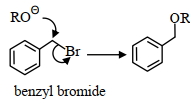
Assertion $(A)$ : $\mathrm{S}_{\mathrm{N}} 2$ reaction of $\mathrm{C}_6 \mathrm{H}_5 \mathrm{CH}_2 \mathrm{Br}$ occurs more readily than the $\mathrm{S}_{\mathrm{N}} 2$ reaction of $\mathrm{CH}_3 \mathrm{CH}_2 \mathrm{Br}$.

Reason $(R)$ : The partially bonded unhybridized p-orbital that develops in the trigonal bipyramidal transition state is stabilized by conjugation with the phenyl ring.

In the light of the above statements, choose the most appropriate answer from the options given below:

  • A
    $(A)$ is not correct but $(R)$ is correct
  • B
    Both $(A)$ and $(R)$ are correct but $(R)$ is not the correct explanation of $(A)$
  • Both $(A)$ and $(R)$ are correct and $(R)$ is the correct explanation of $(A)$
  • D
    $(A)$ is correct but $(R)$ is not correct
Answer

Correct option: C.
Both $(A)$ and $(R)$ are correct and $(R)$ is the correct explanation of $(A)$
c
The benzyl group acts in much the same way using the $\pi$-system of the benzene ring for conjugation with the p-orbital in the transition state.

Need a full question paper?

Generate a complete, print-ready paper with questions like this in minutes — across 16+ boards, with answer keys.

Start Generating Free

Similar questions

An aqueous solution containing $28\%$ by mass of a liquid (mol. mass $= 140$) has a vapour pressure of $160\ mm$ at $37\,^oC$. Find the vapour pressure of the pure liquid $A$ approximately .......... $mm$ . (The vapour pressure of water at $37\,^oC$ is $150\ mm$)
Consider an electrochemical cell: $A ( s )\left| A ^{ n +}( aq , 2 M ) \| B ^{2 n +}( aq , 1 M )\right| B ( s )$. The value of $\Delta H ^{\ominus}$ for the cell reaction is twice that of $\Delta G ^{\ominus}$ at $300 K$. If the emf of the cell is zero,  the $\Delta S ^{\ominus}$ (in $J K ^{-1} mol ^{-1}$ ) of the cell reaction per mole of $B$ formed at $300 K$ is. . . . . . . (Given: $\ell n (2)=0.7, R$ (universal gas constant) $=8.3 J K ^{-1} mol ^{-1} . H , S$ and $G$ are enthalpy, entropy and Gibbs energy, respectively.)
In the given reaction :

$\begin{array}{*{20}{c}}
  O \\ 
  {||} \\ 
  {{C_6}{H_5} - C - C{H_3}} 
\end{array}\mathop {\xrightarrow{{(i)\,B{r_2}/KOH}}}\limits_{(ii)\,{H^ \oplus }} CHB{r_3} + [X]$

$[X]$ will be :

Which of the following inert gas has the smallest ionization energy?
The magnetic moment of a metal ion of first transition series is $2.83 $ $BM$. Therefore it will have unpaired electrons
Which of the following statement is true about ozone layer
Which of the following is correct

Penta acetate of glucose $\xrightarrow[{\operatorname{Re} agent}]{{Tollen's}}$  $+\,ve$ test $(A)$

Penta acetate of glucose $\xrightarrow{{Benedicts}}$ $+\,ve$ test $(B)$

Penta acetate of glucose $\xrightarrow[{\operatorname{Re} agent}]{{Schiffs}}$ $-\,ve$ test $(C)$

Penta acetate of glucose $\xrightarrow{{NaHS{O_3}}}$ $-\,ve$ test $(D)$

Maximum enol content is in
What will be the products obtained at anode and cathode during electrolysis of dilute aqueous solution of $Na _2 SO _4$ ? If Pt electrode is used.
On adding $KI $ to a solution of copper sulphate