MCQ
Given below are two statements: one is labelled as Assertion $(A)$ and the other is labelled as Reason $(R)$.

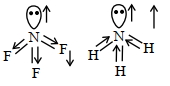
Assertion $(A)$ : $\mathrm{NH}_3$ and $\mathrm{NF}_3$ molecule have pyramidal shape with a lone pair of electrons on nitrogen atom. The resultant dipole moment of $\mathrm{NH}_3$ is greater than that of $\mathrm{NF}_3$.

Reason $(R)$ : In $\mathrm{NH}_3$, the orbital dipole due to lone pair is in the same direction as the resultant dipole moment of the $\mathrm{N}-\mathrm{H}$ bonds. $\mathrm{F}$ is the most electronegative element.

In the light of the above statements, choose the correct answer from the options given below:

  • Both $(A)$ and $(R)$ are true and $(R)$ is the correct explanation of $(A)$
  • B
    $(A)$ is false but $(R)$ is true
  • C
    $(A)$ is true but $(R)$ is false
  • D
    Both $(A)$ and $(R)$ are true but $(R)$ is NOT the correct explanation of $(A)$
Answer

Correct option: A.
Both $(A)$ and $(R)$ are true and $(R)$ is the correct explanation of $(A)$
a
Resultant dipole moment $=0.80 \times 10^{-30} \mathrm{Cm}$

(Image)

Resultant dipole moment $=4.90 \times 10^{-30} \mathrm{~cm}$

(Image)

Need a full question paper?

Generate a complete, print-ready paper with questions like this in minutes — across 16+ boards, with answer keys.

Start Generating Free

Similar questions

Given below are two statements:

Statement $I$ : Nickel is being used as the catalyst for producing syn gas and edible fats.

Statement $II$ : Silicon forms both electron rich and electron deficient hydrides.

In the light of the above statements, choose the most appropriate answer from the options given below:

The surface of copper gets tarnished by the formation of copper oxide. $N _2$ gas was passed to prevent the oxide formation during heating of copper at $1250 K$. However, the $N _2$ gas contains $1$ mole $\%$ of water vapour as impurity. The water vapour oxidises copper as per the reaction given below:

$2 Cu ( s )+ H _2 O ( g ) \longrightarrow Cu _2 O ( s )+ H _2( g )$

$P _{ H _2}$ is the minimum partial pressure of $H _2$ (in bar) needed to prevent the oxidation at $1250 K$. The value of $\ln \left( p _{ H _2}\right)$ is. . . . .

(Given: total pressure $=1$ bar, $R$ (universal gas constant) $=8 JK ^{-1} mol ^{-1}, \ln (10)=2.3$. $Cu ( s )$ and $Cu _2 O ( s )$ are mutually immiscible.

At $1250 K : 2 Cu ( s )+1 / 2 O _2( g ) \longrightarrow Cu _2 O ( s ) ; \Delta G ^\theta=-78,000 J mol ^{-1}$

$H _2( g )+1 / 2 O _2( g ) \longrightarrow H _2 O ( g ) ; \Delta G ^\theta=-1,78,000 J mol ^{-1} ; G$ is the Gibbs energy)

Which buffer solution comprising of the following has its pH value greater than 7?
Which of the following is the most stable
The IUPAC name of Imageis :
Bromination of alkanes involves
The ionization enthalpy of $Na ^{+}$ formation from $Na _{( g )}$ is $495.8\, kJ\, mol ^{-1},$ while the electron gain enthalpy of $Br$ is $-325.0\, kJ\, mol ^{-1}$. Given the lattice enthalpy of $NaBr$ is $-728.4\, kJ\, mol ^{-1}$. The energy for the formation of NaBr ionic solid is $(-)$ ........... $\times 10^{-1} kJ \,mol ^{-1}$
If $HN{O_3}$ changes into ${N_2}O$, the oxidation number is changed by
The equilibrium constant $(K_c) $ for the reaction ${\rm{HA}} + {\rm{B}}$ $\rightleftharpoons$ ${\rm{B}}{{\rm{H}}^+} + {{\rm{A}}^-}$ is $100$. If the rate constant for the forward reaction is $10^5$, then rate constant for the backward reaction is
Triple bond in ethyne is formed from