MCQ
Given below are two statements: One is labelled as Assertion A and the other is labelled as Reason $R$

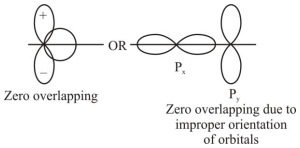
Assertion $A$ : Zero orbital overlap is an out of phase overlap.

Reason $R$ : It results due to different orientation/ direction of approach of orbitals.

In the light of the above statements. Choose the correct answer from the options given below.

  • Both $A$ and $R$ are true and $R$ is the correct explanation of $A$
  • B
    Both $A$ and $R$ are true but $R$ is $NOT$ the correct explanation of $A$
  • C
    $A$ is true but $R$ is false
  • D
    $A$ is false but $R$ is true

Answer

Correct option: A.
Both $A$ and $R$ are true and $R$ is the correct explanation of $A$
a

Need a full question paper?

Generate a complete, print-ready paper with questions like this in minutes — across 16+ boards, with answer keys.

Start Generating Free

Similar questions

In an element going away from nucleus, the energy of particle
${C_2}{H_6}_{(g)} + n{O_2}\, \to \,C{O_2}\,_{(g)} + {H_2}O\,_{(l)}$ In this equation, the ratio of the coefficients of $C{O_2}$ and ${H_2}O$ is
$\begin{matrix}
   C{{H}_{3\,\,\,\,\,\,\,\,\,\,\,}}  \\
   |\,\,\,\,\,\,\,\,\,\,\,\,\,\,\,\,  \\
   C{{H}_{3}}-C=CH-C{{H}_{3}}  \\
\end{matrix}\xrightarrow{Hg{{(OAc)}_{2}}/EtOH}\underset{(90\%)}{\mathop{(A)}}\,$

Product $(A)$ of the above reaction is

$9.2$ grams of ${N_2}{O_{4(g)}}$ is taken in a closed one litre vessel and heated till the following equilibrium is reached ${N_2}{O_{4(g)}}$ $\rightleftharpoons$ $2N{O_{2(g)}}$.At equilibrium, $50\%$ ${N_2}{O_{4(g)}}$ is dissociated. What is the equilibrium constant (in mol litre$^{-1}$) (Molecular weight of ${N_2}{O_4} = 92)$
$2 O _{3}( g ) \rightleftharpoons 3 O _{2}( g )$

At $300 \,K$, ozone is fifty percent dissociated. The standard free energy change at this temperature and $1\, atm$ pressure is $(-)$ $........\,J\, mol ^{-1}$ (Nearest integer)

[Given: $\ln 1.35=0.3$ and $R =8.3 J K ^{-1} mol ^{-1}$ ]

An aqueous solution of glucose is $10\%$ in strength. The volume in which $1\,g-mole$ of it is dissolved will be ............. $\mathrm{L}$
Evaluate the following statements related to group $14$ elements for their correctness.

$(A)$Covalent radius decreases down the group from $\mathrm{C}$ to $\mathrm{Pb}$ in a regular manner.

$(B)$ Electronegativity decreases from $\mathrm{C}$ to $\mathrm{Pb}$ down the group gradually.

$(C)$ Maximum covalence of $\mathrm{C}$ is $4$ whereas other elements can expand their covalence due to presence of $d$ orbitals.

$(D)$ Heavier elements do not form $\mathrm{p} \pi-p \pi$ bonds.

$(E)$ Carbon can exhibit negative oxidation states.

Choose the correct answer from the options given below:

Identify the correct order of reactivity towards electrophilic substitution reaction.

In which of the following pairs, electron gain enthalpies of constituent elements are nearly the same or identical ?

$(A)$ $Rb$ and $Cs$

$(B)$ $Na$ and $K$

$(C)$ $Ar$ and $Kr$

$(D)$ $I$ and $At$

Choose the correct answer from the options given below.

Given below are two statements :

Statement $(I)$ : Kjeldahl method is applicable to estimate nitrogen in pyridine.

Statement $(II)$ : The nitrogen present in pyridine can easily be converted into ammonium sulphate in Kjeldahl method.

In the light of the above statements, choose the correct answer from the options given below.