MCQ
Given below are two statements. One is labelled as
Assertion (A) and the other is labelled as Reason(R).
Assertion (A) : In an insulated container, a gas is adiabatically shrunk to half of its initial volume. The temperature of the gas decreases.
Reason (R) : Free expansion of an ideal gas is an irreversible and an adiabatic process.
In the light of the above statement, choose the correct answer from the options given below :
  • A
    Both (A) and (R) are true and (R) is the correct explanation of (A)
  • B
    (A) is true but (R) is false
  • (A) is false but ( R ) is true
  • D
    Both (A) and (R) are true but (R) is NOT the correct explanation of (A)
Answer

Correct option: C.
(A) is false but ( R ) is true
(C) (A) is false but ( R ) is true
Sol. (A) $T _1 V_1^{\gamma-1}= T _2 V_2^{\gamma-1}$
Temp increases
R) Free expansion is assumed fast, so Adiabatic

Need a full question paper?

Generate a complete, print-ready paper with questions like this in minutes — across 16+ boards, with answer keys.

Start Generating Free

Similar questions

An ideal gas is enclosed in a cylinder at pressure of $2\,atm$ and temperature, $300\,K.$ The mean time between two successive collisions is $6 \times 10^{-8}\, s.$ If the pressure is doubled and temperature is increased to $500\,K,$ the mean time between two successive collisions will be close to
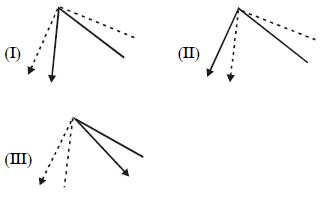
Each of these diagrams is supposed to show two different rays being reflected from the same point on the same plane mirror. Which one of the following is correct ?
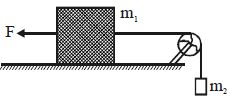
A constant force $F = m_2g/2$ is applied on the block of mass $m_1$ as shown in fig. The string and the pulley are light and the surface of the table is smooth. The acceleration of $m_1$ is
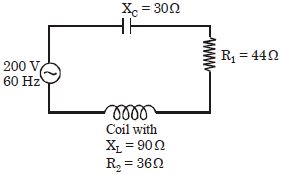
As given in the figure, a series circuit connected across a $200 \,V, 60\, Hz$ line consists of a capacitor of capacitive reactance $30 \,\Omega$, a non-inductive resistor of  $44\, \Omega$, and a coil of inductive reactance $90\,  \Omega$ and resistance $36\, \Omega$. The power dissipated in the coil is.....$W$
The equation of stationary wave is:  $y =2 a \sin \left(\frac{2 \pi nt }{\lambda}\right) \cos \left(\frac{2 \pi x }{\lambda}\right)$ Which of the following is $\ce{NOT}$ correct
Two point masses $m$ and $4 m$ are separated by a distance $d$ on a line. A third point mass $m_0$ is to be placed at a point on the line such that the net gravitational force on it is zero. The distance of that point from the $m$ mass is ..............
Equations $y = 2A \cos ^2 \omega \,t$ and $y = A (\sin \omega t + \cos \omega t )$ represent the motion of two particles.
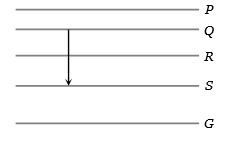
Figure shows the energy levels $P, Q, R, S$ and $G$ of an atom where $G$ is the ground state. A red line in the emission spectrum of the atom can be obtained by an energy level change from $Q$ to $S$. A blue line can be obtained by following energy level change
The refractive index of a particular material is $1.67 $ for blue light, $1.65$ for yellow light and $1.63$ for red light. The dispersive power of the material is .........
A student performs an experiment to determine the Young's modulus of a wire, exactly $2 \mathrm{~m}$ long, by Searle's method. In a particular reading, the student measures the extension in the length of the wire to be $0.8 \mathrm{~mm}$ with an uncertainty of $\pm 0.05 \mathrm{~mm}$ at a load of exactly $1.0 \mathrm{~kg}$. The student also measures the diameter of the wire to be $0.4 \mathrm{~mm}$ with an uncertainty of $\pm 0.01 \mathrm{~mm}$. Take $g=9.8 \mathrm{~m} / \mathrm{s}^2$ (exact). The Young's modulus obtained from the reading is