MCQ
Given below are two statements:

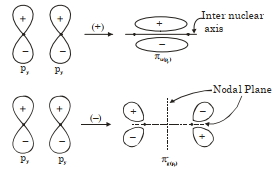
Statement $(I)$ : A $\pi$ bonding $MO$has lower electron density above and below the inter-nuclear asix.

Statement $(II)$ : The $\pi^*$ antibonding $MO$ has a node between the nucles.In the light of the above statements, choose the most appropriate answer from the options given below:

  • A
    Both Statement $I$ and Statement $II$ are false
  • B
    Both Statement $I$ and Statement $II$ are true
  • Statement $I$ is false but Statement $II$ is true
  • D
    Statement $I$ is true but Statement $II$ is false
Answer

Correct option: C.
Statement $I$ is false but Statement $II$ is true
c
A $\pi$ bonding molecular orbital has higher electron density above and below inter nuclear axis

Need a full question paper?

Generate a complete, print-ready paper with questions like this in minutes — across 16+ boards, with answer keys.

Start Generating Free

Similar questions

Uncertainity in position of an electron and helium atom is same. If uncertainity in momentum of electron is $32 \times 10^5$  then uncertainity in momentum of helium atom is
In which of the following processes entropy increases?

$A$. A liquid evaporates to vapour.

$B$. Temperature of a crystalline solid lowered from $130 \mathrm{~K}$ to $0 \mathrm{~K}$.

$C$. $2 \mathrm{NaHCO}_{3(\mathrm{~s})} \rightarrow \mathrm{Na}_2 \mathrm{CO}_{3(\mathrm{~s})}+\mathrm{CO}_{2(\mathrm{~g})}+\mathrm{H}_2 \mathrm{O}_{(\mathrm{g})}$

$D$. $\mathrm{Cl}_{2(g)} \rightarrow 2 \mathrm{Cl}_{(g)}$

Choose the correct answer from the options given below:

For the reaction, following data is given,

$A \rightarrow  B; \ \ \ K_1 = 10^{15}\  exp.\ \left( {\frac{{ - 2000}}{T}} \right)$

$C \rightarrow  D;\ \ \  K_2 = 10^{14}\  exp. \ \left( {\frac{{ - 1000}}{T}} \right)$

The temperature at which $K_1 = K_2$ is ........... $K$ ($exp. = e$)

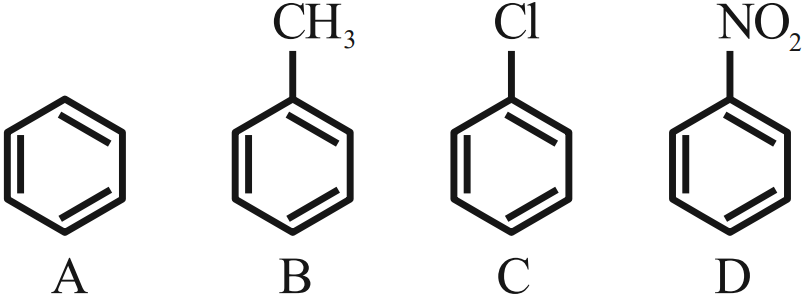
The correct order of reactivity in electrophilic substitution reaction of the following compounds is :

Image
Which of the following tests cannot be used for identifying amino acids?
The number of moles of $KCl$ in $1000\,ml$ of $3\,molar$ solution is
Which one of the following is an inner orbital complex as well as diamagnetic in behaviour (Atomic number : $Zn = 30$, $Cr = 24$, $Co = 27$, $Ni = 28$)
In acidic medium $Mn{{\overset{\Theta }{\mathop{O}}\,}_{4}}$ is an oxidising agent $Mn{{\overset{\Theta }{\mathop{O}}\,}_{4}}+8\overset{\oplus }{\mathop{H}}\,+5{{e}^{-}}\to M{{n}^{+2}}+4{{H}_{2}}O$ 

If $\mathop H\limits^ \oplus  $ ion concentration is doubled, electrode potential of the half cell will

If for ${H_2}_{(g)} + \frac{1}{2}{S_{2(S)}}$ $\rightleftharpoons$ ${H_2}{S_{(g)}}$ and ${H_{2(g)}} + B{r_{2(g)}}$ $\rightleftharpoons$ $2HB{r_{(g)}}$The equilibrium constants are $K_1$ and $K_2$ respectively, the reaction$B{r_2}_{(g)} + {H_2}{S_{(g)}}$ $\rightleftharpoons$ $2HB{r_{(g)}} + \frac{1}{2}{S_{2(S)}}$ would have equilibrium constant
Calculate the enthalpy change for the reaction

$H_2 + F_2 \longrightarrow 2HF$

given that
Bond energy of $H-H$ bond $= 434\, kJ/mol$
Bond energy of $F-F$ bond $= 158\, kJ/mol$
Bond energy of $H-F$ bond $= 565\, kJ/mol$

.....$ kJ$