Question
Given below are two statements:

Statement$-I :$ An elevator can go up or down with uniform speed when its weight is balanced with the tension of its cable.

Statement$-II :$ Force exerted by the floor of an elevator on the foot of a person standing on it is more than his/her weight when the elevator goes down with increasing speed.

In the light of the above statements, choose the correct answer from the options given below :
Answer

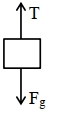
When elevator is moving with uniform speed $T = F _{ g }$

Statement$-2$

When elevator is going down with increasing speed, its acceleration is downward.

Hence 

$W - N =\frac{ W }{ g } \times a$

$N = W \left(1-\frac{ a }{ g }\right) \text { i.e. less than weight. }$

Need a full question paper?

Generate a complete, print-ready paper with questions like this in minutes — across 16+ boards, with answer keys.

Start Generating Free

Similar questions

White light is used to illuminate two slits in a $YDSE$. The separation between the slits is $d$ and the screen is at a distance $D (D > > b)$ from the slits. At a point on the screen directly in front of one of the slits, which of the following wavelengths are missing.
Which of the following statements are wrong about the velocity of sound in air:
Radius of the curved road on national highway is $R$. Width of the road is $b$. The outer edge of the road is raised by $h$ with respect to inner edge so that a car with velocity $v$ can pass safe over it. The value of $h$ is
The given figure represents two isobaric processes for the same mass of an ideal gas, then
A $60\, watt$ bulb operates on $220\,V$ supply. The current flowing through the bulb is
If the equation for the displacement of a particle moving on a circular path is given by $(\theta ) = 2{t^3} + 0.5$, where $\theta $ is in radians and $t$ in seconds, then the angular velocity of the particle after $2 \,sec$ from its start is ......... $rad/sec$
A piece of metal weight $46\, gm$ in air, when it is immersed in the liquid of specific gravity $1.24$ at $27°C$ it weighs $30\, gm.$ When the temperature of liquid is raised to $42°C$ the metal piece weight $30.5\, gm,$ specific gravity of the liquid at $42°C$ is $1.20,$ then the linear expansion of the metal will be
If the potential difference across the internal resistance r1 is equal to the emf E of the battery, then:
Image
An electron has mass $9 \times {10^{ - 31}}\,kg$ and charge $1.6 \times {10^{ - 19}}C$ is moving with a velocity of ${10^6}\,m/s$, enters a region where magnetic field exists. If it describes a circle of radius $0.10\, m$, the intensity of magnetic field must be
Two niclos are crossed to each other. Now one of them is rotated through $60^o$. What percentage of incident light will pass through the system?