MCQ
Given below are two statements:

Statement$-I :$ An elevator can go up or down with uniform speed when its weight is balanced with the tension of its cable.

Statement$-II :$ Force exerted by the floor of an elevator on the foot of a person standing on it is more than his/her weight when the elevator goes down with increasing speed.

In the light of the above statements, choose the correct answer from the options given below :

  • A
    Both statement $I$ and statement $II$ are false
  • Statement $I$ is true but Statement $II$ is false
  • C
    Both Statement $I$ and Statement $II$ are true
  • D
    Statement $I$ is false but Statement $II$ is true
Answer

Correct option: B.
Statement $I$ is true but Statement $II$ is false
b
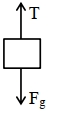
When elevator is moving with uniform speed $T = F _{ g }$

Statement$-2$

When elevator is going down with increasing speed, its acceleration is downward.

Hence 

$W - N =\frac{ W }{ g } \times a$

$N = W \left(1-\frac{ a }{ g }\right) \text { i.e. less than weight. }$

Need a full question paper?

Generate a complete, print-ready paper with questions like this in minutes — across 16+ boards, with answer keys.

Start Generating Free

Similar questions

When resonance is produced in a series $LCR$ circuit, then which of the following is not correct ?
The product of the pressure and volume of an ideal gas is
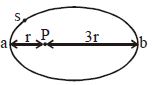
A satellite $S$ moves around a planet $P$ in an elliptical orbit as shown in figure. The ratio the speed of the satellite at point $a$ to that at point $b$ is
Which impurity is doped in $Si $ to form $N-$type semi-conductor?
The north pole of a long horizontal bar magnet is being brought closer to a vertical conducting plane along the perpendicular direction. The direction of the induced current in the conducting plane will be
Activity of a radioactive substance can be represented by various unit. Select correct option
Using the expression $2 d \sin \theta=\lambda$, one calculates the values of $d$ by measuring the corresponding angles $\theta$ in the range $0$ to $90^{\circ}$. The wavelength $\lambda$ is exactly knowns and the error in $\theta$ is constant for all values of $\theta$. As $\theta$ increases from $0^{\circ}$ :
A sample of radioactive element has a mass of $10\, gm$ at an instant $t = 0$.The approximate mass of this element in the sample after two mean lives is ..........$gm$
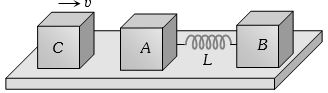
Two blocks $A$ and $B$ each of mass m are connected by a massless spring of natural length L and spring constant $K$. The blocks are initially resting on a smooth horizontal floor with the spring at its natural length as shown in figure. A third identical block $C$ also of mass $m$ moves on the floor with a speed $v$ along the line joining $A$ and $B$ and collides with $A$. Then
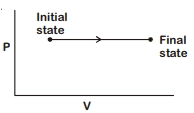
The $P-V$ diagram for an ideal gas in a piston cylinder assembly undergoing a thermodynamic process is shown in the figure. The process is