MCQ
Given below are two statements :

Statement I: Both $\left[\mathrm{Co}\left(\mathrm{NH}_3\right) 6\right]^{3+}$ and $\left[\mathrm{CoF}_6\right]^3$ complexes are octahedral but differ in their magnetic behaviour.

Statement II: $\left[\mathrm{Co}\left(\mathrm{NH}_3\right)\right]^{3+}$ is diamagnetic whereas $\left[\mathrm{CoF} \mathrm{F}_6\right]^{3-}$ is paramagnetic.

In the light of the above statements, choose the correct answer from the options given below:

  • A
     Both Statement $I$ and Statement $II$ are false
  • B
    Statement $I$ is true but Statement $II$ is false
  • C
     Statement $I$ is false but Statement $II$ is true
  •  Both Statement $I$ and Statement $II$ are true

Answer

Correct option: D.
 Both Statement $I$ and Statement $II$ are true
d
In $\left[\mathrm{Co}\left(\mathrm{NH}_3\right)_6\right]^{3+}, \mathrm{Co}^{3+}$ ion is having $3 \mathrm{~d}^6$ configuration.

Electronic configuration of $\mathrm{Co}^{3+}$ $Image$

In presence of $\mathrm{NH}_3$ ligand, pairing of electrons takes place and it becomes diamagnetic complex ion.

In presence of $\mathrm{NH}_3$ ligand $Image$

$\therefore \quad\left[\mathrm{Co}\left(\mathrm{NH}_3\right)_6\right]^{3+}$ is octahedral with $\mathrm{d}^2 \mathrm{sp}^3$ hybridisation and it is diamagnetic in nature.

In case of $\left[\mathrm{CoF}_6\right]^{3-}, \mathrm{Co}$ is in +3 oxidation state and it is having $3 \mathrm{~d}^6$ configuration.

In presence of weak field $\mathrm{F}^{-}$ligand, pairing does not take place.

In presence of $\mathrm{F}^{-}$ligands $Image$

$\therefore \quad \operatorname{In}\left[\mathrm{CoF}_6\right]^{3-}, \mathrm{Co}^{3+}$ is $\mathrm{sp}^3 \mathrm{~d}^2$ hybridised with four unpaired electrons, so it is paramagnetic in nature.

Need a full question paper?

Generate a complete, print-ready paper with questions like this in minutes — across 16+ boards, with answer keys.

Start Generating Free

Similar questions

Given below are two statements: one is labelled as Assertion $(A)$ and the other is labelled as Reason $(R)$.

Assertion $(A)$ : Haloalkanes react with $\mathrm{KCN}$ to form alkyl cyanides as a main product while with $\mathrm{AgCN}$ form isocyanide as the main product.

Reason $(R)$ : $\mathrm{KCN}$ and $\mathrm{AgCN}$ both are highly ionic compounds.

In the light of the above statement, choose the most appropriate answer from the options given below:

What is the correct order of the following elements with respect to their density ?
Which is an acidic hydrocarbon
Which is the decreasing order of stability

$(i)$ $C{H_3} - \mathop C\limits^ + H - C{H_3}$

$(ii)$ $C{H_3} - \mathop C\limits^ + H - O - C{H_3}$

$(iii)$ $C{H_3} - \mathop C\limits^ + H - CO - C{H_3}$

The half life of forward and reverse reactions are $400\,\,sec$ and $100\,\,sec$ and these half lives are independent from the concentration of Reactant then find the equilibrium constant of the reaction
Ethylene possess
Diazonium salt decomposes as ${C_6}{H_5}N_2^ + C{l^ - } \to {C_6}{H_5}Cl + {N_2}$ At ${0\,^o}C$, the evolution of ${N_2}$ becomes two times faster when the initial concentration of the salt is doubled. Therefore, it is
Which one of the following compound gives aspirin on reacting with acetic anhydride in presence of ${H_2}S{O_4}$
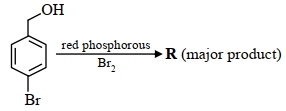
Consider the following reaction. On estimation of bromine in $1.00 g$ of $R$ using Carius method, the amount of $AgBr$ formed (in $g$ ) is. . . .

$\overline{\text { [Given : }}$ Atomic mass of $H =1, C =12, O =16, P =31, Br =80, Ag =108]$

According to Lewis concept which one of the following is not a base