MCQ
Given below are two statements :

Statement I: Both $\left[\mathrm{Co}\left(\mathrm{NH}_3\right) 6\right]^{3+}$ and $\left[\mathrm{CoF}_6\right]^3$ complexes are octahedral but differ in their magnetic behaviour.

Statement II: $\left[\mathrm{Co}\left(\mathrm{NH}_3\right)\right]^{3+}$ is diamagnetic whereas $\left[\mathrm{CoF} \mathrm{F}_6\right]^{3-}$ is paramagnetic.

In the light of the above statements, choose the correct answer from the options given below:

  • A
     Both Statement $I$ and Statement $II$ are false
  • B
    Statement $I$ is true but Statement $II$ is false
  • C
     Statement $I$ is false but Statement $II$ is true
  •  Both Statement $I$ and Statement $II$ are true
Answer

Correct option: D.
 Both Statement $I$ and Statement $II$ are true
d
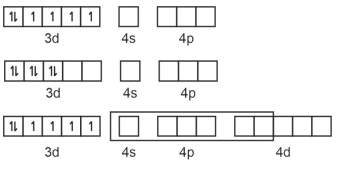
In $\left[\mathrm{Co}\left(\mathrm{NH}_3\right)_6\right]^{3+}, \mathrm{Co}^{3+}$ ion is having $3 \mathrm{~d}^6$ configuration.

Electronic configuration of $\mathrm{Co}^{3+}$ $Image$

In presence of $\mathrm{NH}_3$ ligand, pairing of electrons takes place and it becomes diamagnetic complex ion.

In presence of $\mathrm{NH}_3$ ligand $Image$

$\therefore \quad\left[\mathrm{Co}\left(\mathrm{NH}_3\right)_6\right]^{3+}$ is octahedral with $\mathrm{d}^2 \mathrm{sp}^3$ hybridisation and it is diamagnetic in nature.

In case of $\left[\mathrm{CoF}_6\right]^{3-}, \mathrm{Co}$ is in +3 oxidation state and it is having $3 \mathrm{~d}^6$ configuration.

In presence of weak field $\mathrm{F}^{-}$ligand, pairing does not take place.

In presence of $\mathrm{F}^{-}$ligands $Image$

$\therefore \quad \operatorname{In}\left[\mathrm{CoF}_6\right]^{3-}, \mathrm{Co}^{3+}$ is $\mathrm{sp}^3 \mathrm{~d}^2$ hybridised with four unpaired electrons, so it is paramagnetic in nature.

Need a full question paper?

Generate a complete, print-ready paper with questions like this in minutes — across 16+ boards, with answer keys.

Start Generating Free

Similar questions

General formula of primary alcohol is
The Crystal Field Stabilization Energy $(CFSE)$ and magnetic moment (spin-only) of an octahedral aqua complex of a metal ion $\left(\mathrm{M}^{2+}\right)$ are $-0.8\, \Delta_{0}$ and $3.87\, \mathrm{BM}$, respectively. Identify $\left(\mathrm{M}^{Z+}\right):$
If $0.15\,g$ of a solute dissolved in $15\,g$ of solvent is boiled at a temperature higher by ${0.216\,^o}C$ than that of the pure solvent. The molecular weight of the substance (molal elevation constant for the solvent is ${2.16\,^o}C$) is
Which is the major product of the following reaction ?

$\begin{matrix}
   O\,\,\,\,  \\
   \,||\,\,\,\,  \\
   C{{H}_{3}}-C-Cl\xrightarrow{{{H}_{2}}S}  \\
\end{matrix}$ product

The reaction of ozone with oxygen atoms in the presence of chlorine atoms can occur by a two step process shown below

${O_3}(g)\, + \,C{l^ * }(g)\, \to \,{O_2}(g) + Cl{O^ * }(g)$ ..... $(i)$               $[{K_i} = 5.2 \times {10^9}\,\,L\,mo{l^{ - 1}}\,{s^{ - 1}}]$

$Cl{O^ * }(g) + {O^ * }(g)\, \to \,{O_2}(g) + \,C{l^ * }(g)$ ..... $(ii)$                $[{K_{ii}} = 2.6 \times {10^{10}}\,\,L\,mo{l^{ - 1}}\,{s^{ - 1}}]$

The closest rate constant for the overall reaction 

${O_3}(g){\mkern 1mu}  + {\mkern 1mu} {O^*}(g){\mkern 1mu}  \to {\mkern 1mu} 2{O_2}(g)$ is  ........... $L\,\,mo{l^{ - 1}}\,{s^{ - 1}}$

According to Raoult's law the relative lowering of vapour pressure of a solution of volatile substance is equal to
Which has trigonal bipyramidal shape ?
Which of the following compounds undergoes hydrolysis easily ?
$\mathop {2{N_2}{O_5}}\limits_{(g)} \to \mathop {4N{O_2}}\limits_{(g)} + \mathop {{O_2}}\limits_{(g)} $ what is the ratio of the rate of decomposition of ${N_2}{O_5}$ to rate of formation of $N{O_2}$
Low spin complex of $d^6-$ cation in an octahedral field will have the following energy

($\Delta _o =$ crystal field splitting energy in an octahedral field, $P =$ Electron pairing energy)