MCQ
Given below are two statements :
Statement I: $Ce ^{4+}$ Diamagnetic in nature
Statement II: $Ce ^{4+}$ act as oxidising agent.
In the light of the above statements, choose the most appropriate answer from the options given below :
  • A
    Both Statement I and Statement II are incorrect
  • B
    Statement I is correct but Statement II is incorrect
  • C
    Statement I is incorrect but Statement II is correct
  • Both Statement I and Statement II are correct.
Answer

Correct option: D.
Both Statement I and Statement II are correct.
(D) Both Statement I and Statement II are correct.
- $Ce ^{4+}$ Diamagnetic in nature
- $Ce ^{4+}$ act as oxidising agent.

Need a full question paper?

Generate a complete, print-ready paper with questions like this in minutes — across 16+ boards, with answer keys.

Start Generating Free

Similar questions

Which of the following compound gives oxygen on fast heating

$(I)$ $AgNO_3$          $(II)$ $CaCO_3$
$(III)$ $Pb(NO_3)_2$          $(IV)$ $Na_2CO_3$

Consider the reaction

${N_2}(g)\, + 3{H_2}(g)\, \rightleftharpoons \,2N{H_3}(g)$ 

The equilibrium constant of the above reaction is $K_3$. If pure ammonia is left to dissociate, the partial pressure of ammonia at equilibrium is given by (Assume that $P_{NH_3}<\,< P_{total}$ at equilibrium)

The reaction $A \to B$ follows first order kinetics. The time taken for $0.8\,mole$ of $A$  to produce $ 0.6\,mole$ of $B$ is $1$ hour . What is the time taken for conversion of $0.9\,mole$ of $A$  to produce $0.675\,mole$ of $ B$ ......... $hr$
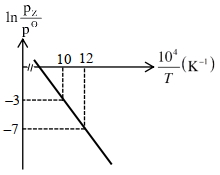
For the reaction $X ( s ) \rightleftharpoons Y ( s )+ Z ( g )$, the plot of $\ln \frac{ p _z}{ p ^\theta}$ versus $\frac{10^4}{T}$ is given below (in solid line), where $p_z$ is the pressure (in bar) of the gas $Z$ at temperature $T$ and $P ^{\ominus}=1$ bar.

(Given, $\frac{ d (\ln K )}{ d \left(\frac{1}{T}\right)}=-\frac{\Delta H^{\ominus}}{ R }$, where the equilibrium constant, $K =\frac{ p _{ z }}{ p ^{\ominus}}$ and the gas constant, $R =8.314$ $\left.J K ^{-1} mol ^{-1}\right)$

($1$) The value of standard enthalpy, $\Delta H ^{\ominus}$ (in $kJ mol ^{-1}$ ) for the reaction is. . . . . . .

($2$) The value of $\Delta S^{\ominus}$ (in $J K ^{-1} mol ^{-1}$ ) for the given reaction, at $1000 K$ is. . . . . . 

Give the answer or quetin ($1$) and ($2$)

Calculate standard free energy change for the reaction $\frac{1}{2}Cu(s) + \frac{1}{2}C{l_2}(g)$ $\rightleftharpoons$ $\frac{1}{2}C{u^{2 + }} + C{l^ - }$ taking place at ${25\,^o}C$ in a cell whose standard e.m.f. is $1.02$  volts .............. $\mathrm{J}$
Gem- dibromide is
Lithium shows similarities to magnesium in its chemical behaviour because
Hydrolysis of acetonitrile in acidic medium gives
The compounds that will give an isomer of  $2; 2-$ dimethyl propane on catalytic hydrogenation are

$(1)$ $\begin{array}{*{20}{c}}
  {C{H_3}CH = C - C{H_3}} \\ 
  {\,\,\,\,\,\,\,\,\,\,|} \\ 
  {\,\,\,\,\,\,\,\,\,\,\,\,\,\,\,\,C{H_3}} 
\end{array}$

$(2)$ $C{H_3}CH = CHC{H_3}$

$(3)$ $\mathop {C{H_3}C}\limits^{\begin{subarray}{l} 
  \,\,\,\,\,\,\,\,{\begin{array}{*{20}{c}}
  {}&H 
\end{array}} \\ 
  \,\,\,\,\,\,\,\,\,\,\,\,\,\,| 
\end{subarray} }  = CHC{H_2}C{H_3}$

$(4)$ $\begin{array}{*{20}{c}}
  {C{H_3}C = C - C{H_3}} \\ 
  {\,\,\,\,\,\,\,|\,\,\,\,\,\,\,\,\,\,\,\,|\,\,\,\,\,\,\,\,\,\,\,\,\,} \\ 
  {\,\,\,\,\,\,\,\,\,\,\,\,\,C{H_{3\,\,}}\,\,C{H_3}\,\,\,\,\,\,\,\,\,\,\,\,\,\,\,\,} 
\end{array}$

Compound $A$ contains $8.7\, \%$ Hydrogen, $74\, \%$ Carbon and $17.3\,\%$ Nitrogen. The molecular formula of the compound is ....

Given : Atomic masses of $C , H$ and $N$ are $12,1$ and $14\, amu$ respectively.

The molar mass of the compound $A$ is $162\, g\, mol ^{-1}$.