MCQ
Given below are two statements:

Statement $I$: Fluorine has most negative electron gain enthalpy in its group.

Statement $II$: Oxygen has least negative electron gain enthalpy in its group.

In the light of the above statements, choose the most appropriate from the options given below.

  • A
     Both Statement $I$ and Statement $II$ are true
  • B
     Statement $I$ is true but Statement $II$ is false
  • C
     Both Statement $I$ and Statement $II$ are false
  •  Statement $I$ is false but Statement $II$ is true
Answer

Correct option: D.
 Statement $I$ is false but Statement $II$ is true
d
Statement$-1$ is false because chlorine has most negative electron gain enthalpy in its group

Need a full question paper?

Generate a complete, print-ready paper with questions like this in minutes — across 16+ boards, with answer keys.

Start Generating Free

Similar questions

The geometry of $ClO_3^ - ,$ according to valence shell electron pair repulsion (VSEPR) theory will be
The colour of liquid ${O_2}$ is
An aqueous pink solution of Cobalt $(II)$ chloride changes to deep blue on addition of excess of $HCl$ this is because
Which of the following is the most correct electron displacement for a nucleophilic reaction to take place ?
If $\lambda_0$ and $\lambda $ be threshold wavelength and wavelength of incident light, the velocity of photoelectron ejected from the metal surface is
Combination of which parameter explain more oxidising strength of $F_2$ as compared to $Cl_2$ in water:
Given below are two statements:

Statements $I$ : $SbCI _5$ is more covalent than $SbCI _3$

Statements $II$: The higher oxides of halogens also tend to be more stable than the lower ones.

In the light of the above statements, choose the most appropriate answer from the options given below

The molar solubility $(mol\;{L^{ - 1}})$ of a sparingly soluble salt $M{X_4}$ is $'s'$. The corresponding solubility product is ${K_{sp}}$. $'s'$ is given in terms of $_{{K_{sp}}}$ by the relation
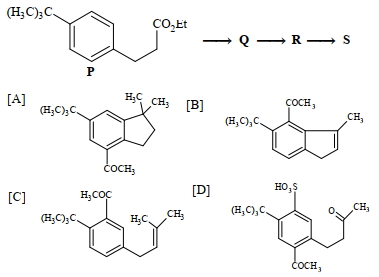
The reaction of compound $\mathbf{P}$ with $CH_3 MgBr$ (excess) in $\left(C_2 \mathrm{H}_5\right)_2 O$ followed by addition of $H_2 O$ gives $Q$. The compound $Q$ on treatment with $H_2 SO_4$ at $0^{\circ} C$ gives $R$. The reaction of $R$ with $CH_3 COC1$ in the presence of anhydrous $AlCl_3$ in $CH_2 Cl_2$ followed by treatment with $H_2 O$ produces compound $S$ [ $Et$ in compound $P$ is ethyl group]

(image)

($1$) The product $S$ is

(image)

($2$) The reactions, $Q$ to $R$ and $R$ to $S$, are

$[A]$ Dehydration and Friedel-Crafts acylation

$[B]$ Aromatic sulfonation and Friedel-Crafts acylation

$[C]$ Friedel-Crafts alkylation, dehydration and Friedel-Crafts acylation

$[D]$ Friedel-Crafts alkylation and Friedel-Crafts acylation

Given the answer quetion ($1$) and ($2$)

Standard molar enthalpy of formation of $CO_2$ is equal to