MCQ
Given below are two statements:

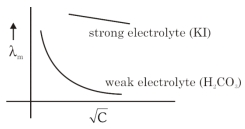
Statement $I:$ For $KI$, molar conductivity increases steeply with dilution.

Statement $II:$ For carbonic acid, molar conductivity increases slowly with dilution. In the light of the above statements, choose the correct answer from the options given below:

  • A
    Both Statement $I$ and Statement $II$ are true
  • Both Statement $I$ and Statement $II$ are false
  • C
    Statement $I$ is true but Statement $II$ is false
  • D
    Statement $I$ is false but Statement $II$ is true
Answer

Correct option: B.
Both Statement $I$ and Statement $II$ are false
b
Statement $I: KI$ is strong electrolyte thus almost constant on dilution.

Statement $II:$ In weak electrolyte it increases, sharply.

Need a full question paper?

Generate a complete, print-ready paper with questions like this in minutes — across 16+ boards, with answer keys.

Start Generating Free

Similar questions

$2p$  orbitals have
Who among the following first prepared a stable compound of noble gas
For the cell $Zn(s)|\,Z{n^{2 + }}(aq)\,||\,{M^x+} \,(aq)|\,M(s),$ different half cells and their standard electrode potentials are given below

  $M^{x+}\,  (aq)\,/M(s)$

$A{u^{3 + }}(aq)/$

$Au(s)$

  $A{g^ + }(aq)/$

$Ag(s)$

$F{e^{3 + }}(aq)/$

$F{e^{2 + }}(aq)$

$F{e^{2 + }}(aq)/$

$Fe(s)$

  $E^o\,M^{x+}$ $\,/M(V)$   $1.40$   $0.80$   $0.77$    $-0.44$

If $E_{Z{n^{2 + }}/Zn}^o =  - 0.76\,V,$ which cathode will given a maximum value of  $E_{cell}^o$ per electron transferred?

$2\, mole$ of $N_2H_4$ loses $16\, mole$ of electron is being converted to a new compound $X$. Assuming that all of the $N$ appears in the new compound. What is the oxidation state of $'N'$ in $X$ ?
The decreasing order of reactivity of the following organic molecules towards $AgNO$ $_{3}$ solution is :
In which compound, the oxidation state of phosphorus is $+4$
The molar conductivity of a solution of a weak acid $HX (0.01\ M )$ is $10$ times smaller than the molar conductivity of a solution of a weak acid $HY (0.10 \ M )$. If $\lambda_{ X }^0 \approx \lambda_{ Y ^{-}}^0$, the difference in their $pK _{ a }$ values, $pK _{ a }( HX )- pK _{ a }( HY )$, is (consider degree of ionization of both acids to be $\ll 1$ )
Among the oxides of nitrogen $N_2O_3,\,N_2O_4$ and $N_2O_5;$  the molecule $(s)$  having nitrogen-nitrogen bond is/are
If bond energy for $H_{2(g)}, Br_{2(g)}$ and $HBr_{(g)}$ is $433, 192$ and $364\, kJ\, mol^{-1}$ respectively then $\Delta H^o$ for the reaction, $H_{2(g)} + Br_{2(g)} \to 2HBr_{(g)}$ is......$ kJ$
Rank in order of increasing rate of reaction towards $EAS$ with bromine in the  presence of $FeBr_3$