MCQ
Given below are two statements .

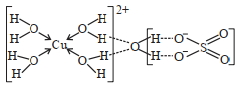
Statement $I :$ In $CuSO _{4} .5 H _{2} O , Cu - O$ bonds are present.

Statement $II :$ In $CuSO _{4} .5 H _{2} O$, ligands coordinating with $Cu$ $(II)$ ion are $O$-and $S$-based ligands.

In the light of the above statements, choose the correct answer from the options given below

  • A
    Both Statement $I$ and Statement $II$ are correct
  • B
    Both Statement $I$ and Statement $II$ are incorrect
  • Statement $I$ is correct but Statement $II$ is incorrect
  • D
    Statement $I$ is incorrect but Statement $II$ is correct
Answer

Correct option: C.
Statement $I$ is correct but Statement $II$ is incorrect
c

Need a full question paper?

Generate a complete, print-ready paper with questions like this in minutes — across 16+ boards, with answer keys.

Start Generating Free

Similar questions

Product $(A)$ is
Assertion : $B_2$ molecule is diamagnetic.
Reason : The highest occupied molecular orbital is of $\sigma $ type.
The rate of the reaction $2{N_2}{O_5} \to 4N{O_2} + {O_2}$ can be written in three ways

$\frac{{ - d\left[ {{N_2}{O_5}} \right]}}{{dt}} = k\left[ {{N_2}{O_5}} \right]$ , 

$\frac{{d\left[ {N{O_2}} \right]}}{{dt}} = k'\left[ {{N_2}{O_5}} \right]$,

$\frac{{d\left[ {{O_2}} \right]}}{{dt}} = k''\left[ {{N_2}{O_5}} \right]$

The relationship between $k$ and $k'$ and between $k$ and $k^{"}$ are

For the reaction $4NH_3 + 5O_2 \to 4NO + 6H_2O$ , if the rate of disappearance of $NH_3$ is $3.6 \times 10^{-3}\, mol\, L^{-1}\,s^{-1}$ , what is the rate of formation of $H_2O$ ?
Dehydrohalogenation of an alkyl halide is
Which of the following represent free radical substitution reaction $(FSR)$, electrophilic addition reaction $(EAR)$ and nucleophilic addition reaction $(NAR)$

$I.$ $CH_3 -CH = CH_2$ $\xrightarrow[{{\text{(CC}}{{\text{l}}_4}{\text{ )}}}]{{{\text{C}}{{\text{l}}_2}}}$ $\begin{array}{*{20}{c}}
{Cl\,\,}\\
{\,\,|\,\,\,\,\,}\\
{C{H_3} - CH - C{H_2}}\\
{\,\,\,\,\,\,\,\,\,\,\,\,\,\,\,\,\,\,\,\,\,\,\,\,\,\,|}\\
{\,\,\,\,\,\,\,\,\,\,\,\,\,\,\,\,\,\,\,\,\,\,\,\,\,\,\,Cl}
\end{array}$

$II.$ $\begin{array}{*{20}{c}}
O\\
{||}\\
{C{H_3} - C - C{H_3}}
\end{array}$ $\xrightarrow[{{}^\Theta OH}]{{{\text{HCN}}}}$ $\begin{array}{*{20}{c}}
{\,\,\,\,\,OH}\\
|\\
{C{H_3} - C - C{H_3}}\\
|\\
{\,\,\,\,\,CN}
\end{array}$

$III.$ $CH_3-CH_2-CH_3$ $\xrightarrow[{hv}]{{C{l_2}}}$ $\begin{array}{*{20}{c}}
{Cl\,\,}\\
{|\,\,\,\,}\\
{C{H_3} - CH - C{H_3}}
\end{array}$

Product $(A)$ is
Assuming pure $2s$ and $2p$ orbitals of carbon are used in forming $CH_4$ molecule, which of the following statement is false?
A gaseous mixture of two substances $A$ and $B$, under a total pressure of $0.8\,atm$ is in equilibrium with an ideal liquid solution. The mole fraction of substance $A$ is $0.5$ in the vapour phase and $0.2$ in the liquid phase. The vapour pressure of pure liquid $A$ $......$ is atm. (Nearest integer)
Given below are two statements:

Statement $(I)$ : $A$ Buffer solution is the mixture of a salt and an acid or a base mixed in any particular quantities.

Statement $(II)$ : Blood is naturally occurring buffer solution whose $\mathrm{pH}$ is maintained by $\mathrm{H}_2 \mathrm{CO}_3 / \mathrm{HCO}_3$ concentrations.

In the light of the above statements, choose the correct answer from the options given below.