MCQ
Given below are two statements :

Statement $I$ : Picric acid is $2, 4, 6$-trinitrotoluene.

Statement $II$ : Phenol$-2, 4-$disulphuric acid is treated with conc. $\mathrm{HNO}_3$ to get picric acid.

In the light of the above statement, choose the most appropriate answer from the options given below :

  • Statement $I$ is incorrect but Statement $II$ is correct.
  • B
    Both Statement $I$ and Statement $II$ are incorrect.
  • C
    Statement $I$ is correct but Statement $II$ is incorrect.
  • D
    Both Statement $I$ and Statement $II$ are correct.

Answer

Correct option: A.
Statement $I$ is incorrect but Statement $II$ is correct.
a
picric acid

$(2,4,6$ - trinitrophenol $)$

Need a full question paper?

Generate a complete, print-ready paper with questions like this in minutes — across 16+ boards, with answer keys.

Start Generating Free

Similar questions

Consider the half-cell reduction reaction

$Mn^{2+} + 2e^- \rightarrow Mn,\, $$E^o = - 1.18\, V$

$Mn^{2+} \rightarrow  Mn^{3+} + e^-,$ $ E^o = - 1.51 \,V$

The $E^o$ for the reaction $3Mn^{2+} \rightarrow  Mn^o + 2Mn^{3+},$

and possibility of the forward reaction are respectively

The compound containing co-ordinate bond is
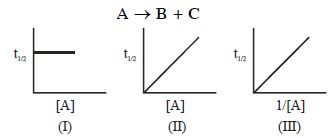
Consider the plots, given below, for the type of reaction

The plots respectively corresponds to the reaction order

Which of the following set has highest sum of $IE$ indica ted as compared to all other sets mentioned
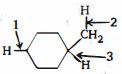
Rank the bond dissociation energies of the bonds indicated with the arrows. (from  smallest to largest).
Given below are two statements:

Statement $I:$ For $KI$, molar conductivity increases steeply with dilution.

Statement $II:$ For carbonic acid, molar conductivity increases slowly with dilution. In the light of the above statements, choose the correct answer from the options given below:

Match the column

  Column $-I$   Column $-II$
$(a)$ $[Pt(NH_3)_3Cl]Br$ $(P)$ Coordination
isomerism
$(b)$ $[Cr(NH_3)_5(NCS)]^{+2}$ $(Q)$ Ionisation
isomerism
$(c)$ $[Co(H_2O)_6]Cl_3$ $(R)$ Linkase
isomerism
$(d)$ $[PtCl_4] [Pt(NH_3)_4]$ $(S)$ Hydrated
isomerism


The noble gases can be separated by
Number of hydrogen atoms which can participate in hyperconjugation in $Y$ is
Consider an electrochemical cell: $A ( s )\left| A ^{ n +}( aq , 2 M ) \| B ^{2 n +}( aq , 1 M )\right| B ( s )$. The value of $\Delta H ^{\ominus}$ for the cell reaction is twice that of $\Delta G ^{\ominus}$ at $300 K$. If the emf of the cell is zero,  the $\Delta S ^{\ominus}$ (in $J K ^{-1} mol ^{-1}$ ) of the cell reaction per mole of $B$ formed at $300 K$ is. . . . . . . (Given: $\ell n (2)=0.7, R$ (universal gas constant) $=8.3 J K ^{-1} mol ^{-1} . H , S$ and $G$ are enthalpy, entropy and Gibbs energy, respectively.)