MCQ
Given below are two statements :

Statement $I$: $\mathrm{S}_8$ solid undergoes disproportionation reaction under alkaline conditions to form $\mathrm{S}^{2-}$ and $\mathrm{S}_2 \mathrm{O}_3{ }^{2-}$

Statement $II$: $\mathrm{ClO}_4^{-}$can undergodisproportionation reaction under acidic condition. In the light of the above statements, choose the most appropriate answer from the options given below :

  • Statement $I$ is correct but statement $II$ is incorrect.
  • B
    Statement $I$ is incorrect but statement $II$ is correct 
  • C
     Both statement $I$ and statement $II$ are incorrect
  • D
    Both statement $I$ and statement $II$ are correct
Answer

Correct option: A.
Statement $I$ is correct but statement $II$ is incorrect.
a
$\mathrm{S}_1: \mathrm{S}_{\mathrm{8}}+12 \mathrm{OH}^{\ominus} \rightarrow 4 \mathrm{~S}^{2-}+2 \mathrm{~S}_2 \mathrm{O}_3^{2-}+6 \mathrm{H}_2 \mathrm{O}$

$\mathrm{S}_2: \mathrm{ClO}_4^{\ominus}$ cannot undergo disproportionation reaction as chlorine is present in it's highest oxidation state.

Need a full question paper?

Generate a complete, print-ready paper with questions like this in minutes — across 16+ boards, with answer keys.

Start Generating Free

Similar questions

Correct increasing order of spin magnetic moment (in $B.M.$) for complexes for

$(I) [FeF_6]^{-3}$

$(II) [V(H_2O)_6]^{+2}$

$(III) [Fe(H_2O)_6]^{+2}$

Acetylation reaction with acetyl chloride is carried out in the presence of which solvent ?
Total possible stereo isomer from given compound will be

$\begin{array}{*{20}{c}}
  {C{H_3} - CH = CH - CH - CH - C{H_3}} \\ 
  {{\mkern 1mu} {\mkern 1mu} {\mkern 1mu} \,\,\,\,\,\,\,\,\,\,\,\,\,\,\,\,\,\,\,\,\,\,\,\,\,\,\,{\mkern 1mu} {\mkern 1mu} |{\mkern 1mu} {\mkern 1mu} {\mkern 1mu} {\mkern 1mu} {\mkern 1mu} {\mkern 1mu} {\mkern 1mu} {\mkern 1mu} {\mkern 1mu} {\mkern 1mu} \,\,\,\,\,\,\,\,\,\,\,{\mkern 1mu} {\mkern 1mu} |{\mkern 1mu} {\mkern 1mu} {\mkern 1mu} {\mkern 1mu} {\mkern 1mu} {\mkern 1mu} {\mkern 1mu} {\mkern 1mu} } \\ 
  {\,\,\,\,\,\,\,\,\,\,\,\,\,\,\,\,\,\,\,\,\,\,\,\,\,\,\,\,\,\,\,OH{\mkern 1mu} {\mkern 1mu} {\mkern 1mu} {\mkern 1mu} \,\,\,\,{\mkern 1mu} {\mkern 1mu} \,\,\,{\mkern 1mu} {\mkern 1mu} OH\,\,} 
\end{array}\,$

${{C}_{6}}{{H}_{5}}OH+ClCOC{{H}_{3}}\xrightarrow{\text{aq}\text{. }NaOH}{{C}_{6}}{{H}_{5}}OCOC{{H}_{3}}$  is an example of
For the gas phase reaction,

$PCl_{5(g)} \rightleftharpoons PCl_{3(g)} + Cl_{2(g)}$

which of the following conditions are correct ?

What is the mass of the precipitate formed when $50\ mL$ of $16.9\%$ solution of $AgNO_3$ is mixed with $50\ mL$ of $5.8\%$ $NaCl$ solution $?$ ............. $\mathrm{g}$ $(Ag = 107.8, N = 14, O = 16, Na = 23,Cl = 35.5)$
Ethylene has high b.p. and high vapour pressure at ${100\,^o}C$ and does not dissolve in water. Hence ethylene is separated by this method
Which of the following is not used to construct salt bridge
Assertion: The aqueous solution of $FeCl_3$ is basic in nature.
Reason: $FeCl_3$ hydrolyses in water.
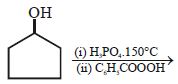
The major product of the following reaction is