MCQ
Given below are two statements :

Statement $I :$ Stopping potential in photoelectric effect does not depend on the power of the light source.

Statement $II :$ For a given metal, the maximum kinetic energy of the photoelectron depends on the wavelength of the incident light.

In the light of above statements, choose the most appropriate answer from the options given below.

Options :

  • A
    Statement $I$ is incorrect but statement $II$ is correct
  • B
    Both Statement $I$ and Statement $II$ are incorrect
  • C
    Statement $I$ is correct but statement $II$ is incorrect
  • Both statement $I$ and statement $II$ are correct
Answer

Correct option: D.
Both statement $I$ and statement $II$ are correct
d
Stopping potential $V _{ S }=\frac{ KE _{\max }}{ e }$

$V _{ S }=\frac{\frac{ hC }{ \lambda }-\phi}{ e }$

Stopping potential does not depend on intensity or power of light used, it only depends on frequency or wavelength of incident light.

So both statements $I$ and $II$ are correct

Need a full question paper?

Generate a complete, print-ready paper with questions like this in minutes — across 16+ boards, with answer keys.

Start Generating Free

Similar questions

A block weighs $W$ is held against a vertical wall by applying a horizontal force $F$. The minimum value of $F$ needed to hold the block is $[\mu < 1]$
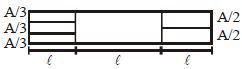
For the shown figure, calculate the equivalent thermal resistance if the bricks made of the same material of conductivity $K$
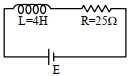
In the given figure, an inductor and a resistor are connected in series with a battery of emf $E$ volt. $\frac{E^a}{2 b }\,J / s$ represents the maximum rate at which the energy is stored in the magnetic field (inductor). The numerical value of $\frac{ b }{ a }$ will be ............
An electromagnetic wave of frequency $3\, GHz$ enters a dielectric medium of relative electric permittivity $2.25$ from vacuum. The wavelength of this wave in that medium will be $.......\,\times 10^{-2} \, cm$
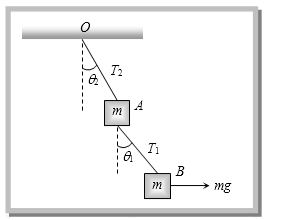
For given systen ${\theta _2}$ ....... $^o$ 
Which of the prism is used to see infra-red spectrum of light
Two spherical bodies $\mathrm{A}$ (radius $6 \mathrm{~cm}$ ) and $\mathrm{B}$ (radius $18 \mathrm{~cm}$ ) are at temperature $\mathrm{T}_1$ and $\mathrm{T}_2$, respectively. The maximum intensity in the emission spectrum of $\mathrm{A}$ is at $500 \mathrm{~nm}$ and in that of $\mathrm{B}$ is at $1500 \mathrm{~nm}$. Considering them to be black bodies, what will be the ratio of the rate of total energy radiated by $A$ to that of $B$ ?
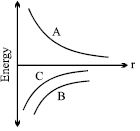
The figure shows the variation of energy with the orbit radius of a body in circular planetary motion. Find the correct statement about the curves $A, B$ and $C$
Two radioactive materials $X_1$ and $X_2$ contain same number of nuclei. If $6\,\lambda {s^{ - 1}}$ and $4\,\lambda {s^{ - 1}}$ are the decay constants of $X_1$ and $X_2$ respectively the ratio of number of nuclei, undecayed of $X_1$ to that of $X_2$ will be $\left( {\frac{1}{e}} \right)$ after a time 
The dimensions of the product $\mu_{0} \varepsilon_{0}$ are related to those of velocity as