MCQ
Given below are two statements:

Statement $I$: Tropolone is an aromatic compound and has $8 \pi$ electrons.

Statement $II$: $\pi$ electrons of $ > C = O$ group in tropolone is involved in aromaticity.

In the light of the above statements, choose the correct answer from the options given below:

  • A
    Both Statement $I$ and Statement $II$ are true
  • Statement $I$ is true but Statement $II$ is false
  • C
    Statement $I$ is false but Statement $II$ is true
  • D
    Both Statement $I$ and Statement $II$ are false
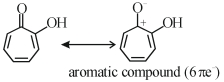
Answer

Correct option: B.
Statement $I$ is true but Statement $II$ is false
b
Tropolone is an aromatic compound and has $8 \pi$ electrons $\left(6 \pi e ^{-}\right.$are endocyclic and $2 \pi e^{-}$ are exocyclic) and $\pi$ electrons of $ > C = O$ group in tropolone is not involved in aromaticity.

Need a full question paper?

Generate a complete, print-ready paper with questions like this in minutes — across 16+ boards, with answer keys.

Start Generating Free

Similar questions

If dissociation for reaction, $PC{l_5}$ $\rightleftharpoons$ $PC{l_3} + C{l_2}$ is $20\%$ at $1$ $atm$. pressure. Calculate ${K_c}$
For the reaction $(1)$ and $(2)$ :
$A \rightleftharpoons  B + C ....(1)$
$D \rightleftharpoons  2E ....(2)$
Given $K_{P_1} : K_{P_2} : : 9 : 1$
If the degree dissociation of $A$ and $D$ be same then the total pressure at equilibria $(1)$ and $(2)$ are in the ratio (Assume reaction are started with equal number of moles of $A$ and $D$).
What is the decreasing order of reactivity amongst the following compounds towards aromatic electrophilic substitution

$I.$ Chlorobenzene

$II.$ Benzene

$III.$ Anilinium chloride

$IV.$ Toluene

${Image}$

The product $"A"$ and $"B"$ formed in above reactions are

In $Br{F_3}$ molecule,the lone pairs occupy equatorial positions to minimize
For the reaction : $N_2 (g)$ $+$ $3H_2(g)$ $\rightarrow$ $2NH_3(g)$, $\Delta H =\, -24\,Kcal$ at  $427\,^oC$ and $200\,atm$ . Calculate magnitude of internal energy change (in $Kcal\,\Delta U$), if $168\,gm$ $N_2$ gas and $30 \,gm$ $H_2$ gas are allowed to react completely ( $100\%$ reaction yield) to form $NH_3$ gas at $427\,^oC$ and $200\,atm$......$Kcal$
The vapour pressure of acetone $(CH_3COCH_3)$ at $20\,^oC$ is $185\, torr$. When $1.2\, g$ of non volatile substance was dissolved in $100\, g$ of acetone at $20\,^oC$, its vapour pressure was $183\, torr$. The molar mass $(g\, mol^{-1})$ of the substance is
Which is the best description of the behaviour of bromine in the reaction given below ${H_2}O + B{r_2} \to HOBr + HBr$
Which molecule does not show zero dipole moment
In a chemical equilibrium $A + B$ $\rightleftharpoons$ $C + D$, when one mole each of the two reactants are mixed, $0.6 $ mole each of the products are formed. The equilibrium constant calculated is