MCQ
Given below are two statements:
Statement I : The correct order of first ionization enthalpy values of Li, Na, F and Cl is Na<Li<Cl<F. Statement II : The correct order of negative electron gain enthalpy values of Li, Na, F and Cl is Na<Li<F< Cl
  • A
    Both Statement I and Statement II are true
  • B
    Both Statement I and Statement II are false
  • C
    Statement I is false but Statement II is true
  • D
    Statement I is true but Statement II is false
Answer

Need a full question paper?

Generate a complete, print-ready paper with questions like this in minutes — across 16+ boards, with answer keys.

Start Generating Free

Similar questions

$C{r_2}{O_7}^{ - 2}/{H^ \oplus }\xrightarrow[{{{200}\,^o}C}]{{{H_2}{O_2}}} 'X'\xrightarrow{{On\,Standing}} 'Y'_{(aq.sol)}$

Select the correct option for $'X'$ and $'Y'$

Given below are two statements :

Statement $I:$ Upon heating a borax bead dipped in cupric sulphate in a luminous flame, the colour of the bead becomes green.

Statement $II:$ The green colour observed is due to the formation of copper(I) metaborate.

In the light of the above statements, choose the most appropriate answer from the options given below :

The solubility of $Ca ( OH )_{2}$ in water is ....... .

[Given : The solubility product of $Ca ( OH )_{2}$ in water $\left.=5.5 \times 10^{-6}\right]$

Which of the following complexes has maximum $CFSE$?
A mixture of ethyl alcohol and propyl alcohol has a vapour pressure of $290 \,mm$ at $300\, K.$ The vapour pressure of propyl alcohol is $200\, mm.$ If the mole fraction of ethyl alcohol is $0.6,$ its vapour pressure ( in $mm$) at the same temperature will be
$\begin{array}{*{20}{c}}
  {C{H_3} - CH - C{H_3}\xrightarrow{{PB{r_3}}}X\xrightarrow{{{\text{Mg/ether}}}}Y\,\xrightarrow{{{{\text{H}}_2}{\text{O/}}{{\text{H}}^ + }}}} \\ 
  {|\,\,\,\,\,\,\,\,\,\,\,\,\,\,\,\,\,\,\,\,\,\,\,\,\,\,\,\,\,\,\,\,\,\,\,\,\,\,\,\,\,\,\,\,\,\,\,\,\,\,\,\,\,\,\,\,\,\,\,\,\,\,\,\,\,\,\,\,\,\,\,\,\,\,} \\ 
  {OH\,\,\,\,\,\,\,\,\,\,\,\,\,\,\,\,\,\,\,\,\,\,\,\,\,\,\,\,\,\,\,\,\,\,\,\,\,\,\,\,\,\,\,\,\,\,\,\,\,\,\,\,\,\,\,\,\,\,\,\,\,\,\,\,\,\,\,\,\,} 
\end{array}$ The final product is
When two atomic orbitals combine they form
The structure of $4-$ methyl pentene $-2$  is
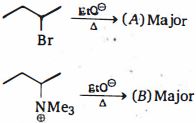
Relation between $(A)$ and $(B)$ is
In thermodynamics, which one of the following properties is not an intensive property