Question
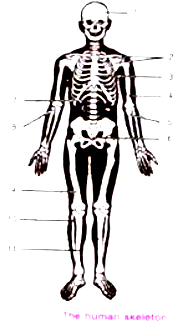
Given below is a diagram of human skeleton. Name the bones numbered 1-11.
Answer

1: Cranium/Skull
2: Clavicle, Scapula
3: Sternum
4: Humerus
5: Ulna;
6: Coccyx;
7: floating ribs;
8: Radius;
9: Femur;
10: Fibula;
11: Tibia

Need a full question paper?

Generate a complete, print-ready paper with questions like this in minutes — across 16+ boards, with answer keys.

Start Generating Free

Similar questions

Match the activities in Column I with the respective organisation in Column II (there can be one or more than one activity).

Column I

(Activity)

Column II

(Organisation)

(i) To extend relief to victims of earthquake.

(ii) To lay pharmaceutical standards for Important drugs.

(iii) Arranging ambulance in emergencies.

(iv) To suggest quarantine measures.

(v) Training of midwives.

(vi) Procuring and supplying blood for transfusion.

(A) Red Cross

(B) WHO

Give any four reasons why water is necessary in our body.
Observe the given figure and answer the following:
Image
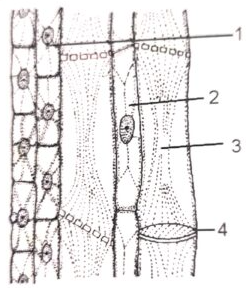
(i) What does the figure show?
(ii) Label the parts numbered 1-4.
(iii) Give the function of part 3.
Describe five main branches of biology.
The following two chemical reactions are supposed to indicate a certain process occurring in the green plants under two different conditions:
(a) $C_6H_{12}O_6 + 6O_2 → 6CO_2$ + _______ + $38$ ATP
(b) $C_6H_{12}O_6$ → ________ + $2 CO_2 + 2 ATP$
(i) Fill in the blank in each reaction.
(ii) Name the process represented by the two reactions.
(iii) What are the conditions under which the two reactions (a) and (b) are occurring respectively?
Difference between
Bone and Cartilage
Observe the figure given below and answer the questions that follow:
Image
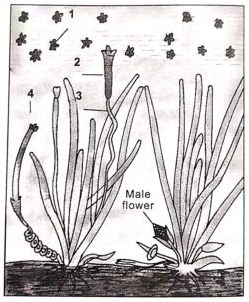
(i) Label parts 1-4 shown in the figure.
(ii) By what method do you think the flower is being pollinated.
(ii) Explain the mechanism of pollination shown above.
Describe the living and non-living things.
How do chordates differ from non-chordates?
What are the various parts of a typical vertebra?