Question
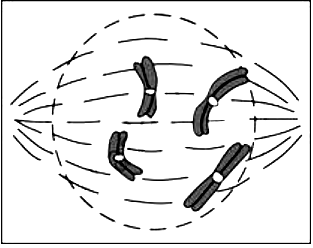
Given below is a diagram representing a stage during mitotic cell division. Study it carefully and answer the question that follow.

How will you differentiate between mitosis and meiosis on the basis of the chromosome number in the daughter cells?

Answer

Difference between mitosis and meiosis based on the chromosome number in daughter cells:

Mitosis

Meiosis

Chromosome number remains the same as that of parent cells.

Daughter cells receive only half the number of chromosomes from parent cells.

Need a full question paper?

Generate a complete, print-ready paper with questions like this in minutes — across 16+ boards, with answer keys.

Start Generating Free

Similar questions

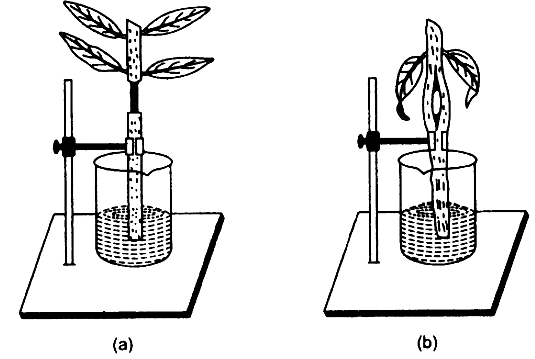
The diagram given below represents the result of an experiment conducted on two freshly taken shoots of a green herbaceous plant. The lower ends dip in the water.

(i) What is the aim of the experiment?
(ii) Some parts of the stem in both the shoots have been removed. Name the conducting tissue in shoot A and in shoot B, that has been removed.
(iii) What are the results of this experiment?
Draw a neat and labelled diagram of longitudinal section of kidney.
A candidate in order to study the process of osmosis has taken 3 potato cubes and put them in 3 different beakers containing 3 different solutions. After 24 hours, in the first beaker the potato cube increased in size, in the second beaker the potato cube decreased in size and in the third beaker there was no change in the size of the potato cube. The following diagram shows the result of the same experiment:
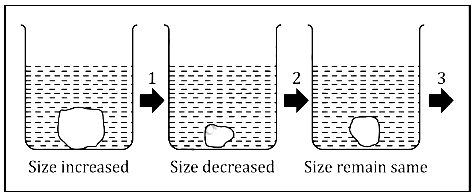
(i) Give the technical terms of the solutions used in beakers, 1, 2 and 3.
(ii) In beaker 3, the size of the potato cube remains the same. Explain the reason in brief.
(iii) Write the specific feature of the cell sap of root hairs which helps in absorption of water.
(iv) What is osmosis?
(v) How does a cell wall and a cell membrane differ in their permeability?
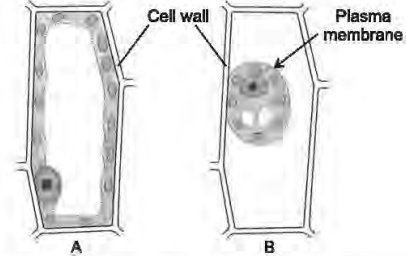
Given below are diagrams of plant cells as seen under the microscope after having been placed in two different solutions :

Image

(i) What is the technical term for the condition of the following?
(a) Cell A
(b) Cell B
(ii) From the solutions given in brackets (water, strong sugar solution, $1 \%$ salt solution) name the solution into which :
(a) Cell A
(b) Cell B, was placed before being viewed under the microscope,
(iii) Under what conditions in the soil will the root hair cell resemble:
(a) Cell A
(b) Cell $B$
Differentiate between:

Afferent and Efferent Nerve.

Leaves of the sensitive plant wilt and droop down on a slight touch. What mechanism brings about this change?
Draw a labeled diagram of the inner ear. Name the part of the inner ear that is responsible for static balance in human beings.
Differentiate between the following:
Lymphocytes and Monocytes
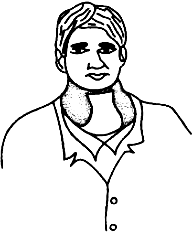
The sketch below shows a certain condition in an individual:

(i) Name the condition.
(ii) What is the underlying cause of this condition?
(iii) Name two other conditions that could have resulted due to a similar cause.
(iv) Which hormone is required for iodine synthesis?
(v) Where is the thyroid gland located?
(vi) The hormone secreted by the thyroid gland is controlled from which hormone?
Why is it necessary to place a plant in the dark before starting an experiment on photosynthesis? Explain.