Question
Given below is an experimental set up to study a particular process:
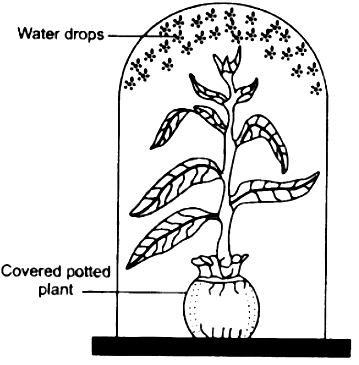
(i) Name the process being studied.
(ii) Explain the process named in (i) above.
(iii) Why is the pot covered with a plastic sheet?
(iv) Mention one way in which this process is beneficial to the plant.
(v) Suggest a suitable control for this experiment.
Answer

(i)
  1. Cuticle,
  2. Upper epidermis,
  3. Palisade tissue,
  4. Spongy parenchyma,
  5. Guard cell of a stoma.
    (ii) In the day time dotted arrow shows the path of $CO_2$​​​​​​​ while solid arrow shows the path of oxygen. A night dotted arrow shows the path of oxygen while the solid arrow shows the path of $CO_2:$
    (iii) Yes, we can add one more arrow in the figure to show the loss of water during transpiration.
    (iv) Only one leaf vein has been shown in this section.

Need a full question paper?

Generate a complete, print-ready paper with questions like this in minutes — across 16+ boards, with answer keys.

Start Generating Free

Similar questions

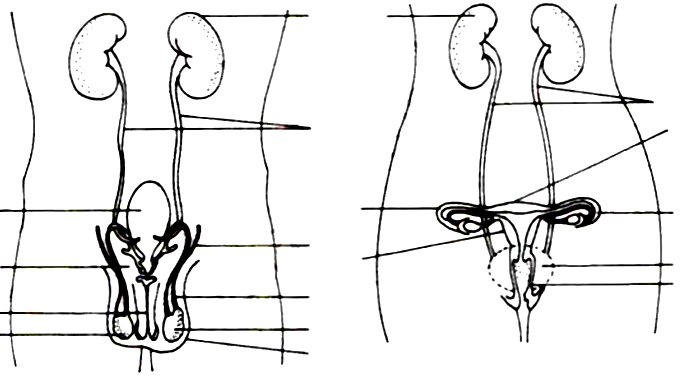
Label the folowing diagram
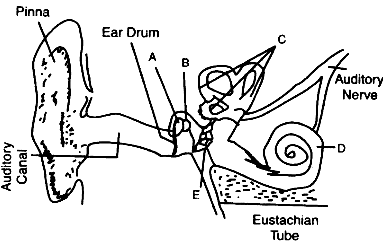
Given below is the diagram of the human ear. Study the diagram and then answer the questions that follow:
(i) What role does the eardrum play in hearing?
(ii) What common term is given to the parts labeled A, B, and E?
(iii) Would there be any difference if these three parts mentioned in (ii) above were replaced by one by one? Why?
(iv) Give the biological term for the parts labeled C and D.
(v) Name the fluid which fills the parts mentioned in (iv) above.
(vi) State the functions of the ear.
Describe briefly the ways how a mammalian embryo is protected
What is a monohybrid cross? How did Mendel perform this cross?
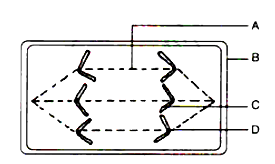
The diagram given alongside represents a stage in cell division.
Study the same and answer the questions that follow:

(i) Identify the stage of cell division.
(ii) Name the parts labeled A,B,C and D.
(iii) What is the unique feature observed in this stage?
(iv) Where does this type of cell division usually occur?
(v) How many daughter cells are formed from this type of cell division?
(vi) Is the dividing cell shown a plant or an animal cell?
Give a reason to support your answer.
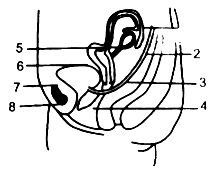
The below diagram represents the vertical view of the human female reproductive system.

(i) Label the parts indicated by the guidelines 1 to 8.
(ii) How does the uterus prepare for the reception of a zygote?
(iii) What happens to the uterus if fertilization takes place?
(iv) What happens to the uterus if fertilization has failed to take place?
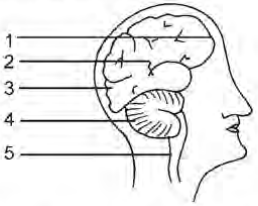
Study the diagram and answer the following questions:

Image
(i) What disabilities would result from damage to part 3 and damage to part 4?
(ii) Name the brain membranes.
(iii) What is meningitis?
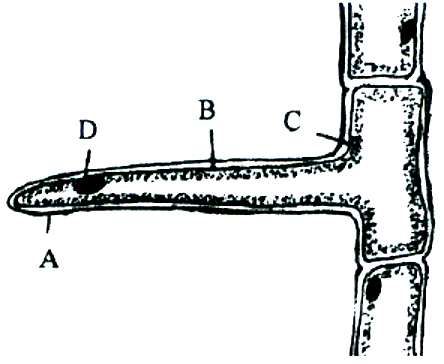
The diagram below represents a layer of epidermal cells showing a fully grown root hair. Study the diagram and answer the questions that follow:
Draw a diagram of the above root hair cell as it would appear when a concentrated solution of fertilizers is added near it.
Differentiate between the following:Plasmolysis and deplasmolysis
Give a labeled diagram of thymus gland.