Question
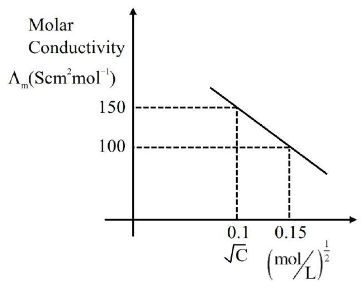
Given below is the plot of the molar conductivity vs $\sqrt{\text { concentration }}$ for KCl in aqueous solution.
Image
If, for the higher concentration of KCl solution, the resistance of the conductivity cell is $100 \Omega$, then the resistance of the same cell with the dilute solution is ' $x$ ' $\Omega$.
The value of $x$ is ___________ (Nearest integer)

Answer

150
$\mathrm{R}=\rho \frac{\ell}{\mathrm{A}}$
$
\begin{gathered}
\kappa=\mathrm{G}_{\mathrm{l}} \mathrm{G}^{*} \mathrm{G}=\frac{1}{\mathrm{R}} ; \kappa=\frac{1}{\rho} \\
\mathrm{G}^{*}=\frac{\ell}{\mathrm{A}} \\
\mathrm{R}=\text { Resistance } \\
\rho=\text { Resistivity } \\
\frac{\ell}{\mathrm{A}}=\text { cell constant }\left(\mathrm{G}^{*}\right) \\
\frac{\kappa_{\mathrm{c}}}{\kappa_{\mathrm{d}}}=\frac{\mathrm{R}_{\mathrm{d}}}{\mathrm{R}_{\mathrm{c}}} ; \lambda_{\mathrm{m}}=\frac{\kappa \times 1000}{\mathrm{C}} \\
\frac{\kappa_{\mathrm{c}}}{\kappa_{\mathrm{d}}}=\frac{\left(\lambda_{\mathrm{m}} \cdot \mathrm{C}\right)}{\left(\lambda_{\mathrm{m}} \cdot \mathrm{C}\right)_{\mathrm{d}}}=\frac{\mathrm{R}_{\mathrm{d}}}{\mathrm{R}_{\mathrm{c}}} \quad \begin{array}{l}
\mathrm{c}=\text { concentrated sol. } \\
\mathrm{d}=\text { diluted solution }
\end{array} \\
\frac{100 .(0.15)^{2}}{150 .(0.1)^{2}}=\frac{\mathrm{R}_{\mathrm{d}}}{100} \quad \\
\mathrm{R}_{\mathrm{d}}=150 \Omega
\end{gathered}
$

Need a full question paper?

Generate a complete, print-ready paper with questions like this in minutes — across 16+ boards, with answer keys.

Start Generating Free

Similar questions

Resistance of a decimolar solution between two electrodes $0.02\,\,meter$ apart and $0.0004\,\, m^2$ in area was found to be $50\,\, ohm.$ Specific conductance $(k)$ is .......... $\mathrm{S\,m}^{-1}$
In dilute aqueous $H _2 SO _4$, the complex diaquodioxalatoferrate($II$) is oxidized by $MnO _4^{-}$. For this reaction, the ratio of the rate of change of $\left[ H ^{+}\right]$to the rate of change of $\left[ MnO _4\right]$ is
Number of optical isomers possible for $2$ - chlorobutane..........
Moles of conc.$HNO_3$ required to oxidise one mole sulphur is :

$S + HNO_3 \rightarrow  H_2SO_4 + 6NO_2 + 2H_2O$

The reaction of calcium with water is represented by the equation $Ca + 2H_2O \to  Ca(OH)_2 + H_2$ What volume of $H_2$ at $STP$ would be liberated when $8\, gm$ of calcium completely reacts with water? .......... $\mathrm{cm}^{-3}$
Number of unpaired electrons in $F{e^{ + 3}}(Z = 26)$ is
Consider the following equations:

$2 Fe ^{2+}+ H _{2} O _{2} \rightarrow x A + y B$

(in basic medium)

$2 MnO _{4}^{-}+6 H ^{+}+5 H _{2} O _{2} \rightarrow x ^{\prime} C + y ^{\prime} D + z ^{\prime} E$

(in acidic medium)

The sum of the stoichiometric coefficients $x , y , x ^{\prime}, y ^{\prime}$ and $z ^{\prime}$ for products $A , B , C , D$ and $E ,$ respectively, is............

Basicity of $H_3BO_3$ is :
In Carius method for estimation of halogens, 180 mg of an organic compound produced 143.5 mg of AgCl . The percentage composition of chlorine in the compound is _________ $\%$.
[Given : molar mass in $g mol ^{-1}$ of Ag : 108, $Cl =35.5]$
Number of moles of $SnCl_2$ required for the reduction of $1$ mole of $K_2Cr_2O_7$ into $Cr_2O_3$ is (in acidic medium)