Question
Given:$\sec A=\frac{29}{21}$, evaluate $: \sin A -\frac{1}{\tan A }$

Answer

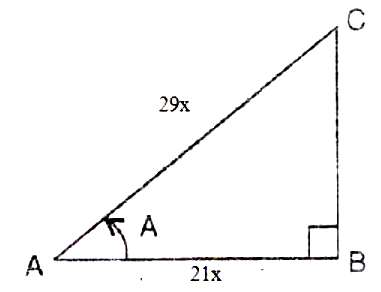
Consider the diagram below :


$\sec A=\frac{29}{21}$
i.e. $\frac{\text { hypotenuse }}{\text { base }}=\frac{29}{21}$
$\Rightarrow \frac{ AC }{ AB }=\frac{29}{21}$
Therefore if length of $AB = 21x$ , length of $AC = 29x$
Since
$AB^2 + BC^2 = AC^2\dots ...[$Using Pythagoras Theorem$]$
$(21x)^2 + BC^2 = ( 29x)^2$
$BC^2 = 841x^2 – 441x^2 =400x^2$
$BC = 20x \dots...($perpendicular$)$
Now
$\sin A =\frac{\text { perpendicular }}{\text { hypotenuse }}=\frac{20 x}{29 x}=\frac{20}{29}$
$\tan A =\frac{\text { perpendicular }}{\text { base }}=\frac{20 x}{21 x}=\frac{20}{21}$
Therefore
$\sin A -\frac{1}{\tan A }$
$=\frac{20}{29}-\frac{1}{\frac{20}{21}}$
$=\frac{20}{29}-\frac{21}{20}$
$=-\frac{209}{580}$

Need a full question paper?

Generate a complete, print-ready paper with questions like this in minutes — across 16+ boards, with answer keys.
Start Generating Free

Similar questions

Ms Mehta teaches maths in a school. One day after teaching the lesson of number system, she wanted to check the understanding of the students of her class. So, she wrote two numbers, $\frac{3}{11}$ and $0 . \overline{52}$ on the blackboard and asked few questions based on them. You please try to answer the following questions asked by Ms Mehta.
Q.1. The decimal expansion of $\frac{3}{11}$ is:
(a) terminating
(b) non-terminating
(c) non-terminating non-repeating
(d) non-terminating repeating
Q.2. $0 . \overline{52}$ is:
(a) non-terminating non repeating
(b) non-terminating repeating
(c) non-terminating
(d) terminating
Q.3. The decimal form of $\frac{3}{11}$ is:
(a) 0.27 (b) 0.2727 (c) $0 . \overline{27}$ (d) 0.3
Q.4. $0 . \overline{52}$ as a vulgar fraction becomes:
(a) $\frac{52}{99}$ (b) $\frac{52}{100}$ (c) $\frac{26}{25}$ (d) $\frac{13}{25}$
Q.5. The sum of $0 . \overline{52}$ and $\frac{3}{11}$ is:
(a) $\frac{79}{99}$ (b) $\frac{70}{99}$ (c) $\frac{52}{99}$ (d) $\frac{40}{99}$
A dealer marks his goods $45\%$ above the cost price and then allows $20\%$ discount on it. What is the cost price of an article on which he gains $Rs.960?$
$375$ persons can be accommodated in a room whose dimensions are in the ratio of $6 : 4 : 1.$ Calculate the area of the four walls of the room if the each person consumes $64\ m^3$ of air.
Prove that: $\frac{1}{\log _8 36}+\frac{1}{\log _9 36}+\frac{1}{\log _{18} 36}=2$
Solve :$\frac{34}{3 x+4 y}+\frac{15}{3 x-2 y}=5;\frac{25}{3 x-2 y}-\frac{8.50}{3 x+4 y}=4.5$
Use graph paper for this question. Take $2 \ cm = 1$ unit on both the axes.$(i)$ Draw the graphs of $x + y + 3 = 0$ and $3x - 2y + 4 = 0$. Plot only three points per line.$(ii) $Write down the coordinates of the point of intersection of the lines.$(iii)$ Measure and record the distance of the point of intersection of the lines from the origin in $cm.$
Construct an isosceles triangle in which: $AB = AC, BC = 6 \ cm$ and $\angle B = 75^\circ $
Simplify the following :$\frac{3 \sqrt{2}}{\sqrt{6}-\sqrt{3}}-\frac{4 \sqrt{3}}{\sqrt{6}-\sqrt{2}}+\frac{2 \sqrt{3}}{\sqrt{6}+2}$
Prove that if the diagonals of a quadrilateral bisect each other at right angles then it is a rhombus.
If $\frac{1}{x}-\frac{2}{3 b}+1=0$, find the value of $b$ when $\frac{2 x+4}{8}-\frac{3-2 x}{12}=\frac{x-3}{6}$