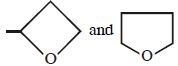
MCQ
Given two compounds are ............. 
  • A
    Ring chain isomer
  • B
    Position isomer
  • C
    Functional isomer
  • D
    Diastereomer

Answer

Need a full question paper?

Generate a complete, print-ready paper with questions like this in minutes — across 16+ boards, with answer keys.

Start Generating Free

Similar questions

What is the molar solubility of $Al(OH)_3$ in $0.2\, M\, NaOH$ solution? Given that, solubility product of $Al(OH)_3 = 2.4 \times 10^{-24}$ 
At a given temperature, the equilibrium constant for reaction $PC{l_5}_{(g)}$ $\rightleftharpoons$ $PC{l_3}_{(g)} + C{l_2}_{(g)}$ is $2.4 \times {10^{ - 3}}$. At the same temperature, the equilibrium constant for reaction $PC{l_3}_{(g)} + C{l_2}_{(g)}$ $\rightleftharpoons$ $PC{l_5}_{(g)}$ is
An inorganic Compound $'\mathrm{X}^{\prime}$ on treatment with concentrated $\mathrm{H}_{2} \mathrm{SO}_{4}$ produces brown fumes and gives dark brown ring with $\mathrm{FeSO}_{4}$ in presence of concentrated $\mathrm{H}_{2} \mathrm{SO}_{4} .$ Also Compound $'\mathrm{X}'$ gives precipitate $'Y',$ when its solution in dilute $\mathrm{HCI}$ is treated with $\mathrm{H}_{2} \mathrm{~S}$ gas. The precipitate $'Y'$ on treatment with concentrated $\mathrm{HNO}_{3}$ followed by excess of $\mathrm{NH}_{4} \mathrm{OH}$ further gives deep blue coloured solution, Compound $'X'$ is :
The rate coefficient $(k)$ for a particular reactions is $1.3 \times 10^{-4}\,M^{-1}\, s^{-1}$ at $100\,^oC,$ and $1.3 \times 10^{-3}\,M^{-1}\,s^{-1}$ at $150\,^oC$. What is the energy of activation $(E_A)$ (in $kJ$ ) for this reaction? ( $R =$ molar gas constant $= 8.314\,JK^{-1}\,mol^{-1}$ )
Adding of $C{l_2}$ to benzene in the presence of $AlC{l_3}$ is an example of
Which of the following pairs of substances illustrate the law of multiple proportions
The freezing points of equimolar solutions of glucose, $KN{O_3}$ and $AlC{l_3}$ are in the order of
Which one given below is a non-reducing sugar ?
In the reactions given below, identify the element undergoing oxidation and reduction:
$3 Fe_3 O_4(s)+8 Al(s) \rightarrow 9 Fe(s)+4 Al_2 O_3(s)$
Which forms a crystal of $NaCl$