Question
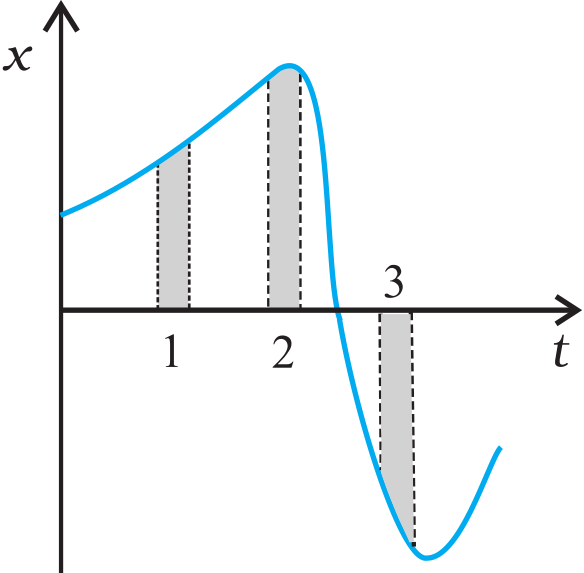
Gives the x-t plot of a particle in one-dimensional motion. Three different equal intervals of time are shown. In which interval is the average speed greatest, and in which is it the least? Give the sign of average velocity for each interval.

Answer

Interval 3(Greatest), Interval 2(Least) Positive (Intervals 1 & 2), Negative (Interval 3) The average speed of a particle shown in the x-t graph is obtained from the slope of the graph in a particular interval of time. It is clear from the graph that the slope is maximum and minimum restively in intervals 3 and 2 respectively. Therefore, the average speed of the particle is the greatest in interval 3 and is the least in interval 2. The sign of average velocity is positive in both intervals 1 and 2 as the slope is positive in these intervals. However, it is negative in interval 3 because the slope is negative in this interval.
Need a full question paper?

Generate a complete, print-ready paper with questions like this in minutes — across 16+ boards, with answer keys.

Start Generating Free

Similar questions

Write Stefan's law and with the help of it establish a relation between the rate of fall in temperature and rate of emission of radiation.
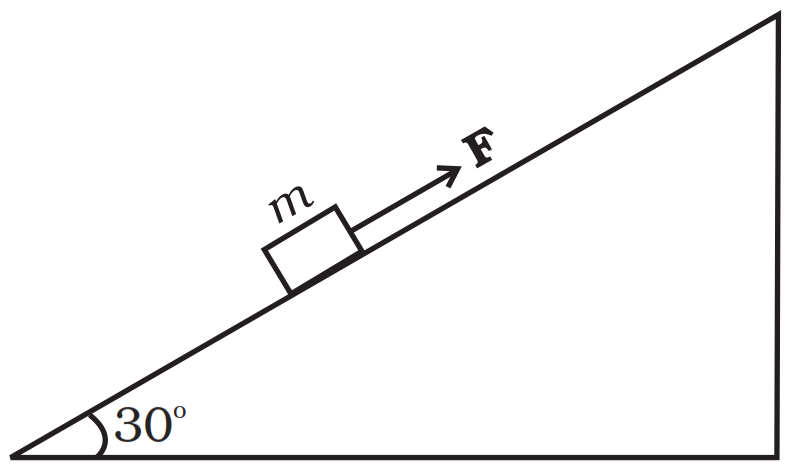
A block of mass $1\ kg$ is pushed up a surface inclined to horizontal at an angle of $30^\circ$ by a force of $10N$ parallel to the inclined surface. The coefficient of friction between block and the incline is $0.1$. If the block is pushed up by $10m$ along the incline, calulate.
  1. Work done against gravity.
  2. Work done against force of friction.
  3. Increase in potential energy.
  4. Increase in kinetic energy.
  5. Work done by applied force.
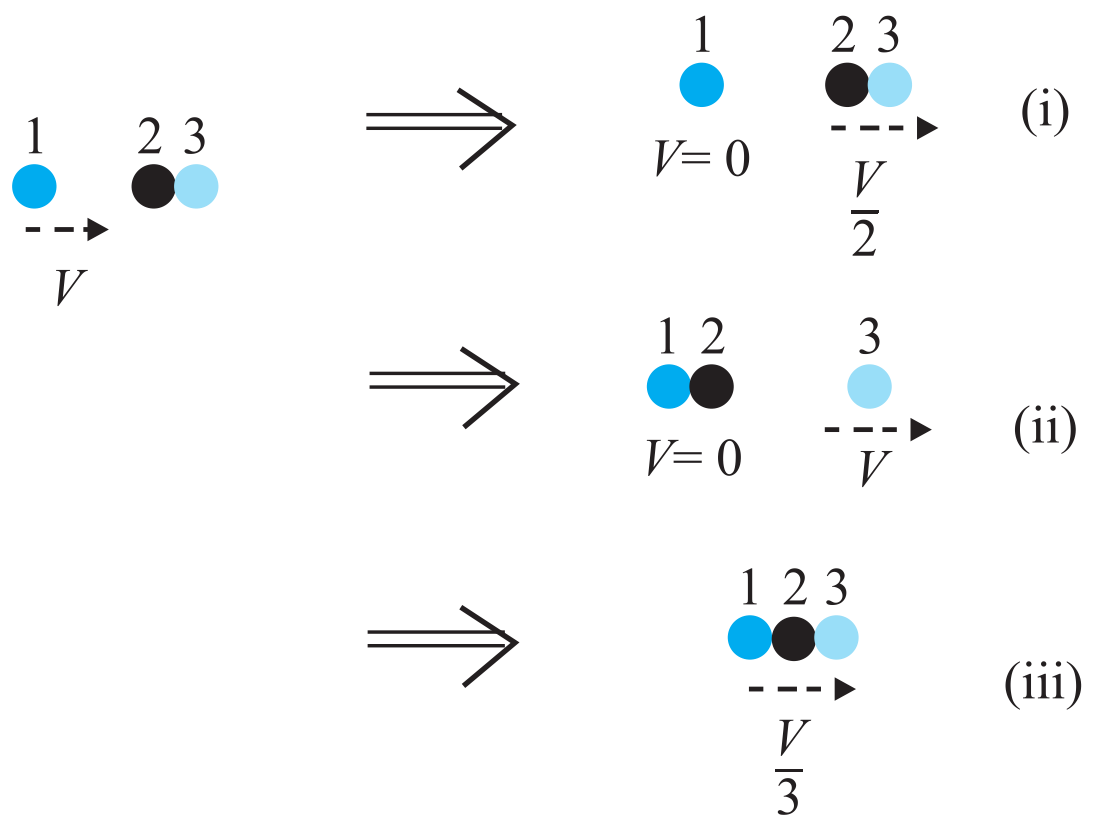
Two identical ball bearings in contact with each other and resting on a frictionless table are hit head-on by another ball bearing of the same mass moving initially with a speed V. If the collision is elastic, which of the following is a possible result after collision?
  1. An electron moves along a circle of radius 1m in a perpendicular magnetic field of strength 0.50T. What would be its speed? Is it reasonable?
  2. If a proton moves along a circle of the same radius in the same magnetic field, what would be its speed?
What is the frequency of a second pendulum in an elevator moving up with an acceleration of $\frac{\text{g}}{2}$?
Two masses $8kg$ and $12kg$ are connected at the two ends of a light inextensible string that goes over a frictionless pulley. Find the acceleration of the masses, and the tension in the string when the masses are released.
A point particle of mass $0.1kg$ is executing S.H.M. of amplitude of $0.1m$. When the particle passes through the mean position, its kinetic energy is $8 \times 10^{-3}$ joule. Obtain the equation of motion of this particle if the initial phase of oscillation is $45^\circ$
Two capacitors of capacitances $20.0pF$ and $50.0pF$ are connected in series with a $6.00V$ battery. Find:
  1. The potential difference across each capacitor.
  2. The energy stored in each capacitor.
Two ball bearings of mass m each moving in opposite directions with equal speed v collide head-on with each other. Predict the outcome of the collision, assuming it to be perfectly elastic.
A uniform field of $2.0NC^{-1}$ exists in space in x-direction.
  1. Taking the potential at the origin to be zero, write an expression for the potential at a general point (x, y, z).
  2. At which points, the potential is $25V$?
  3. If the potential at the origin is taken to be $100V$, what will be the expression for the potential at a general point?
  4. What will be the potential at the origin if the potential at infinity is taken to be zero? Is it practical to choose the potential at infinity to be zero?